-
- CNC Panel SawCNC Router MachineAutomatic Edge Banding MachineSix Sided CNC Drilling Machine
- Application
![news]()
Can Six-Sided CNC Drilling Machines Handle Slotting, Grooving, And Chamfering Operations?
Views: 0 Author: Site Editor Publish Time: 2025-06-09 Origin: Site
![facebook sharing button]()
![twitter sharing button]()
![line sharing button]()
![wechat sharing button]()
![linkedin sharing button]()
![pinterest sharing button]()
![whatsapp sharing button]()
![sharethis sharing button]()
In today's fast-paced and highly competitive woodworking industry, manufacturers are under constant pressure to increase productivity, reduce costs, and offer more versatile product lines. As customer demands grow more complex and customized furniture designs become the norm, the tools and machinery used in production must evolve to keep up.
This has led to a rising demand for multifunctional CNC machines—especially those that can go beyond basic drilling tasks to include slotting, grooving, and chamfering within a single production cycle. Traditionally, these processes required separate machines, additional labor, and multiple handling steps, resulting in time delays and alignment inconsistencies.
Enter the six-sided CNC drilling machine, a powerful innovation designed not only to drill all six faces of a workpiece but also to integrate advanced routing capabilities such as slotting and grooving. But can these machines really perform multiple operations with precision and efficiency?
Capabilities Beyond Drilling
While traditional CNC machines focus primarily on drilling holes, modern six-sided CNC drilling machines—especially those engineered for panel furniture manufacturing—are evolving into multifunctional processing centers. In addition to precision drilling on all six surfaces, these advanced machines can now perform slotting, grooving, and chamfering operations with speed and accuracy, eliminating the need for secondary machining stations.
Slotting: Precision for Structural Panel Assembly
Slotting is a crucial function in cabinet and furniture production, especially for assembling back panels, drawer slides, and joint structures. Six-sided CNC machines can execute both horizontal and vertical slots, aligned perfectly with the drilling layout. This ensures tight-fitting joints and improved structural integrity without the need to reposition the panel or use separate slotting routers.
Grooving: Smooth Channels for Functional Design
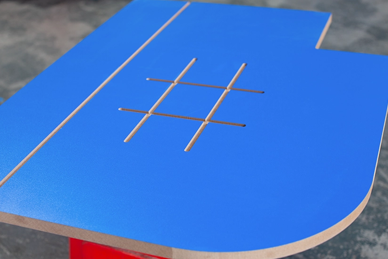
Grooves are essential for incorporating embedded components, such as aluminum trims, decorative inlays, or sliding door tracks. With programmable depth and width control, six-sided CNC machines deliver consistent grooving results—even on large or varying batches. This eliminates inconsistencies caused by manual setups and allows for the integration of multiple groove patterns in a single pass.
Chamfering: Clean Edges, Refined Finishes
Chamfering involves beveling or rounding the edges of a panel for either visual enhancement or ergonomic purposes. It is especially useful in modern furniture designs where minimalism and detail matter. Select six-sided CNC machines include routing heads or optional tooling modules capable of applying light chamfers to edges, improving both appearance and user comfort.
Design Features That Enable These Functions
The ability of a six-sided CNC drilling machine to perform not only drilling but also slotting, grooving, and chamfering relies heavily on advanced engineering and intelligent machine design. These machines are built with versatility and precision in mind, allowing them to serve as multi-operation workstations in high-speed production environments. Let’s explore the key design features that make these expanded functions possible.
Multi-Axis Servo Positioning for Complex Movements
At the core of a six-sided CNC machine’s precision is its multi-axis servo control system. Unlike basic CNC routers, these machines are equipped with high-speed, high-torque servo motors that control movements across the X, Y, Z, and additional rotational axes. This precise motion control enables the machine to adjust tool positions and angles dynamically—essential for accurately executing complex grooves, slots, and edge bevels on all six sides of a panel.
Whether it’s adjusting for varying panel thicknesses or navigating intricate grooving patterns, multi-axis servo systems ensure repeatability and ultra-fine control without manual repositioning.
Powerful Spindles for Routing Operations
Routing operations like grooving and chamfering require more than just a drill motor—they demand powerful spindles capable of sustained high-speed rotation and stable cutting under load. Six-sided CNC drilling machines from leading manufacturers like Foshan Pallas CNC Equipment Manufacturing Co., Ltd. integrate these heavy-duty spindles into their design, giving the machine the power needed to mill precise channels and shaped edges.
These spindles are often customizable with different RPM ranges and tool compatibility, making them suitable for a wide range of materials—from MDF and particle board to hardwoods and laminated panels.
Optional Tool Magazines and Secondary Processing Heads
To further expand functionality, many advanced models of six-sided CNC machines feature automatic tool changers (ATCs) or tool magazines, allowing the system to switch between drill bits, routers, and chamfer tools without manual intervention. This feature is especially valuable in batch processing, where different edge treatments or groove sizes are required across various parts in a single run.
Some machines also come equipped with secondary processing heads—additional units that operate in tandem with the main drill spindles to carry out routing or chamfering tasks simultaneously. This multitasking capability significantly shortens production cycles and ensures a higher throughput.

Material and Panel Support
One of the most important advantages of a six-sided CNC drilling machine is its ability to process a wide range of panel materials with consistent precision. In furniture manufacturing, diversity in material types and thicknesses is common, and the machine’s flexibility must match this demand. From affordable substrates to high-end decorative panels, six-sided CNC machines are engineered to handle them all.
Common Panel Materials Supported
1. Medium-Density Fiberboard (MDF)
MDF is one of the most frequently used materials in furniture and cabinet production. Its uniform texture and smooth surface make it ideal for drilling, grooving, and edge profiling. Six-sided CNC drilling machines can easily penetrate MDF without splintering or tear-out, ensuring clean, accurate holes and slots.
2. Plywood
Plywood offers higher strength and durability, often used in structural furniture parts. However, it contains multiple layers with alternating grain direction, making precise machining more challenging. Advanced six-sided CNC machines use high-speed spindles and sharp tooling to maintain edge quality and accuracy even in layered materials.
3. Particle Board
Used widely for budget-friendly furniture, particle board is lightweight but brittle. Machines must apply precise pressure and spindle speed control to avoid chipping. Six-sided CNC machines with servo-controlled drilling and clamping systems ensure optimal results, even with this more delicate material.
Support for Varying Thicknesses and Composite Panels
Modern CNC drilling systems are designed with flexible material handling capabilities:
Panel thickness detection systems adjust drilling depths and clamping pressure automatically.
Machines can handle thin laminates (as small as 10mm) and thicker engineered boards (up to 60mm or more), depending on the model.
Composite panels like laminated MDF, melamine boards, and even lightweight honeycomb-core panels are compatible, thanks to smart pressure control and tool adaptability.
Multifunctional Shaping Across Materials
The combination of powerful routing spindles and adaptive servo controls allows the machine to carry out slotting, grooving, and chamfering—even on varied material densities and finishes. This is especially useful in factories that produce both custom furniture and mass-produced cabinetry, where the ability to switch materials without tool change delays is a major productivity boost.
Advantages of Integrated Slotting and Grooving in Six-Sided Machines
Modern woodworking requires more than just drilling—it demands precise, multifunctional machining to meet the needs of increasingly complex furniture designs. By integrating slotting and grooving functions directly into six-sided CNC drilling machines, manufacturers can realize a range of operational and quality advantages.
Eliminates the Need for Secondary Routing Machines
Traditionally, slotting and grooving operations were handled on separate CNC routers or manual machines, requiring additional setup, repositioning, and operator time. With six-sided CNC machines equipped for routing functions, all these steps are combined into a single automated cycle. This reduces floor space requirements, minimizes labor, and eliminates bottlenecks between workstations.
Speeds Up Production with One-Pass Processing
Six-sided machines can drill, slot, groove, and even chamfer in one continuous pass, greatly reducing overall cycle times. Panels no longer need to be transported between machines or re-clamped for different operations, enabling true high-speed processing. This is especially beneficial for large-scale production lines where time and throughput are critical.
Ensures Better Alignment and Dimensional Accuracy
When all machining operations are performed in a single clamping position, the risk of misalignment is virtually eliminated. The same coordinate system controls drilling and grooving, ensuring that dowel holes, slots, and channels are precisely placed and properly spaced. This results in:
Tighter joint tolerances
Consistent product quality
Fewer defects and rework
Conclusion
Six-sided CNC drilling machines have evolved from being high-efficiency drilling tools to true all-in-one machining solutions. With the ability to handle drilling, slotting, grooving, and edge processing in a single cycle, these machines bring unmatched value to woodworking operations—particularly in the fast-paced world of cabinet, panel, and furniture production.
By eliminating redundant steps, improving accuracy, and accelerating production workflows, integrated six-sided machines enable manufacturers to scale efficiently without compromising quality. For businesses looking to modernize their production lines, a multifunctional CNC drilling machine is not just an upgrade—it’s a smart investment in the future of intelligent manufacturing.
To explore advanced models like the KN-612B, KN-612DZ, or KN-2312 series, and learn how they can transform your operations, visit www.kihonmachine.com or contact Foshan Pallas CNC Equipment Manufacturing Co., Ltd. for expert consultation and custom solutions.

![English]()
![zhifufuben]()