-
- CNC Panel SawCNC Router MachineAutomatic Edge Banding MachineSix Sided CNC Drilling Machine
- Application
![news]()
What Is An Automatic Edge Banding Machine And How Does It Work?
Views: 0 Author: Site Editor Publish Time: 2025-06-26 Origin: Site
![facebook sharing button]()
![twitter sharing button]()
![line sharing button]()
![wechat sharing button]()
![linkedin sharing button]()
![pinterest sharing button]()
![whatsapp sharing button]()
![sharethis sharing button]()
In the fast-evolving world of woodworking and furniture manufacturing, precision and efficiency are paramount. One essential piece of equipment that has transformed modern woodworking is the automatic edge banding machine. This machine streamlines the process of applying protective and decorative edging to wood panels, ensuring not only aesthetic appeal but also durability and enhanced structural integrity.
Automatic edge banding machines have become indispensable in large-scale production environments, allowing manufacturers to achieve high-quality finishes with minimal labor and reduced error. Among the notable manufacturers in this field, Foshan Pallas CNC Equipment Manufacturing Co., Ltd. stands out for its innovative technology, robust build quality, and versatile applications that meet the diverse needs of today’s woodworking industry.
Machine Components and Structure
Understanding the structure and components of an automatic edge banding machine is fundamental to appreciating its role in woodworking. These machines are complex assemblies that integrate several precise mechanical and electronic systems to deliver consistent, high-quality edge banding.
1. Feeding System: Automatic Conveying and Positioning
The feeding system is the entry point for the panels that require edge banding. Automatic feeding mechanisms convey the raw wood panels into the machine and position them accurately for processing. This system typically includes conveyor belts, rollers, and positioning clamps.
Foshan Pallas machines utilize advanced sensor technology to detect the panel size and orientation, ensuring that each board is correctly aligned before the edge banding process begins. This automated feeding eliminates the need for manual handling, reducing labor and the risk of damage to panels.
2. Gluing System: Hot Melt Glue or PUR Glue Application
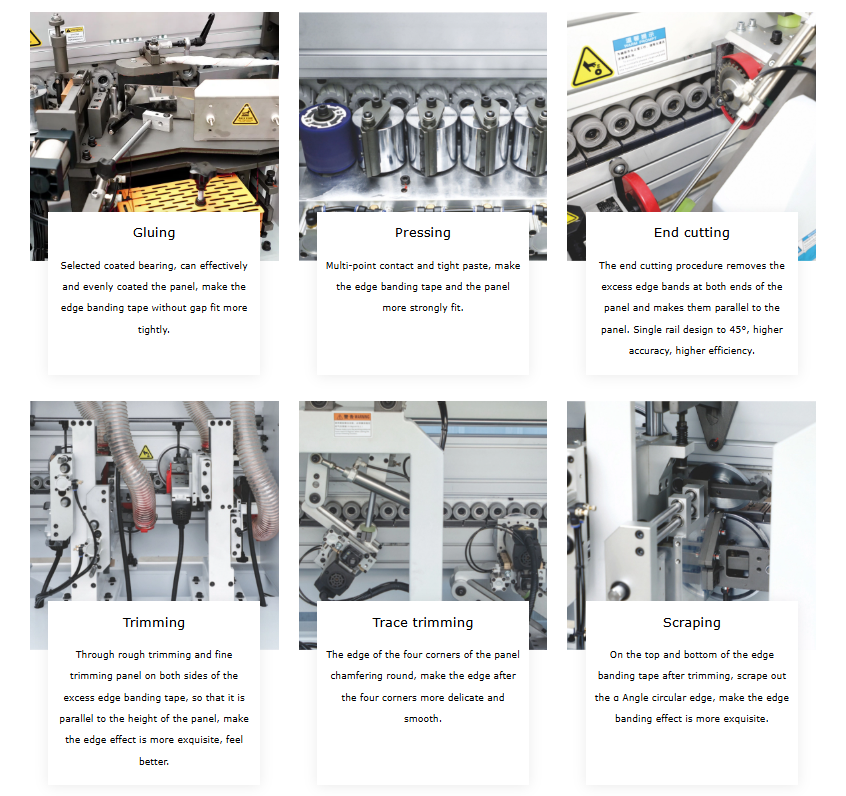
Edge banding requires an adhesive to bond the edging material to the panel surface. The gluing system applies this adhesive uniformly on the edge banding tape.
Foshan Pallas automatic edge banding machines offer flexibility by supporting both hot melt glue and PUR (polyurethane reactive) glue systems. Hot melt glue is widely used due to its quick setting time and cost-effectiveness, while PUR glue provides superior moisture resistance and stronger adhesion, making it suitable for high-end applications.
The gluing system ensures precise temperature control and consistent glue application, which are critical for durable and neat bonding.
3. Edge Banding Unit: Tape Application and Pressing
The core function of the machine is performed by the edge banding unit. Here, the edge banding tape—made from materials such as PVC, ABS, wood veneer, or melamine—is automatically fed, heated, and pressed onto the edge of the panel.
The pressing rollers or wheels apply consistent pressure to ensure the tape adheres properly without bubbles or gaps. This unit accommodates various tape thicknesses and widths, allowing customization according to product specifications.
4. Trimming Units: Rough Trimming, Fine Trimming, and Scraping
After the tape is applied, the excess material is removed through multiple trimming processes to achieve a smooth finish flush with the panel surface.
Rough trimming: Removes the bulk of the excess tape.
Fine trimming: Refines the edge for precision.
Scraping: Cleans any residual glue or roughness.
Foshan Pallas machines feature high-speed cutters and scrapers that operate with exacting accuracy to prevent damage to the panel while ensuring seamless edges.
5. Polishing and Buffing Systems
To further enhance the edge finish, polishing and buffing units smooth out the surface, remove sharp edges, and improve the visual quality of the panel.
These units may include abrasive belts or rollers and are often adjustable to accommodate different material types and desired finishes.
6. Control System: PLC and Touchscreen Interface
Modern automatic edge banding machines are controlled by sophisticated PLC (Programmable Logic Controllers) combined with user-friendly touchscreen interfaces.
Operators input the parameters such as panel size, tape type, feed speed, and trimming settings. The system coordinates all machine components, monitors operational status, and provides real-time diagnostics and safety controls.
Foshan Pallas machines boast intuitive control systems that reduce operator training time and enhance production reliability.

Working Process Overview
The automatic edge banding machine’s operation integrates multiple sequential steps to deliver precise and efficient edge finishing. Below is a step-by-step overview of the typical workflow.
Step 1: Panel Loading and Automatic Positioning
Raw panels are loaded onto the feeding system, either manually or via automatic loaders for higher-volume production lines.
Once on the conveyor, sensors detect panel dimensions and position it precisely using clamps or stops. This ensures that the panel edge aligns perfectly with the tape application system.
Step 2: Glue Application and Heating
The machine applies a thin, uniform layer of adhesive to the edge banding tape or panel edge, depending on the system configuration.
Precise temperature control ensures that the glue reaches optimal viscosity for strong adhesion without damaging the tape or panel.
Step 3: Edge Band Tape Application
The heated adhesive tape is fed from rolls and pressed firmly onto the panel edge.
Pressing rollers ensure the tape adheres evenly, adapting to any slight variations in panel thickness or surface.
Step 4: Automated Trimming and Finishing
Excess tape is trimmed through a multi-stage cutting process—starting with rough trimming to remove the bulk, followed by fine trimming and scraping for a smooth, flush finish.
The trimming units are synchronized with the panel feed to maintain speed without sacrificing accuracy.
Step 5: Polishing and Buffing
The polished rollers or abrasive belts smooth the edges to remove burrs or roughness, ensuring a professional finish ready for assembly or sale.
Step 6: Tape Cutting and Finished Product Output
Finally, the machine automatically cuts the tape at the panel ends and pushes the finished product onto the unloading conveyor or stacking system, ready for the next production phase.
Advantages of Automation
Automatic edge banding machines bring transformative benefits to woodworking operations, particularly in industrial or high-volume settings.
1. Increased Production Efficiency and Consistent Quality
Automation drastically reduces the time required for edge banding compared to manual or semi-automatic methods. Continuous operation with minimal human intervention leads to higher throughput.
The machine’s precision ensures uniform tape application and trimming, resulting in consistent quality across large production runs and fewer rejects.
2. Lower Labor Costs and Simplified Operation
By automating complex tasks such as feeding, gluing, pressing, trimming, and finishing, companies can reduce reliance on skilled labor.
The intuitive control interfaces further simplify operations, enabling operators with minimal training to run the machines effectively.
3. Stable and Reliable Automated Process
The integration of PLC controls and sensor feedback ensures that the machine maintains optimal settings, adapts to variations in panel or tape materials, and promptly detects faults to minimize downtime.
This reliability translates into steady production schedules and better inventory management.
Conclusion
Automatic edge banding machines are a cornerstone technology in modern woodworking and furniture manufacturing, offering unmatched speed, precision, and quality. Through advanced mechanical design and intelligent control systems, they automate the once labor-intensive and error-prone process of edge finishing.
Foshan Pallas CNC Equipment Manufacturing Co., Ltd. exemplifies excellence in this field with its range of automatic edge banding machines that feature robust feeding systems, versatile adhesive application, precise trimming, and user-friendly controls.
By investing in such automated solutions, manufacturers can meet growing market demands, reduce costs, and produce high-quality products that enhance customer satisfaction.
For companies seeking to upgrade their woodworking operations, exploring Foshan Pallas’ automatic edge banding machines is a step toward efficiency, innovation, and competitive advantage.

![English]()
![zhifufuben]()