-
- CNC Panel SawCNC Router MachineAutomatic Edge Banding MachineSix Sided CNC Drilling Machine
- Application
![news]()
CNC Panel Saw Benefits in Furniture Manufacturing
Views: 0 Author: Site Editor Publish Time: 2026-07-04 Origin: Site
![facebook sharing button]()
![twitter sharing button]()
![line sharing button]()
![wechat sharing button]()
![linkedin sharing button]()
![pinterest sharing button]()
![whatsapp sharing button]()
![sharethis sharing button]()
Scaling high-volume furniture manufacturing eventually exposes the mechanical and operational limits of manual sliding table saws. Facility managers and production heads often reach a critical threshold where manual cutting processes can no longer keep pace with assembly demands. Relying on manual material handling introduces inconsistent tolerances, high material waste, and severe operator fatigue. These variables create immediate bottlenecks in the sizing department that cascade into downstream assembly processes, disrupting sensitive operations like edge banding, dowel insertion, and CNC routing.
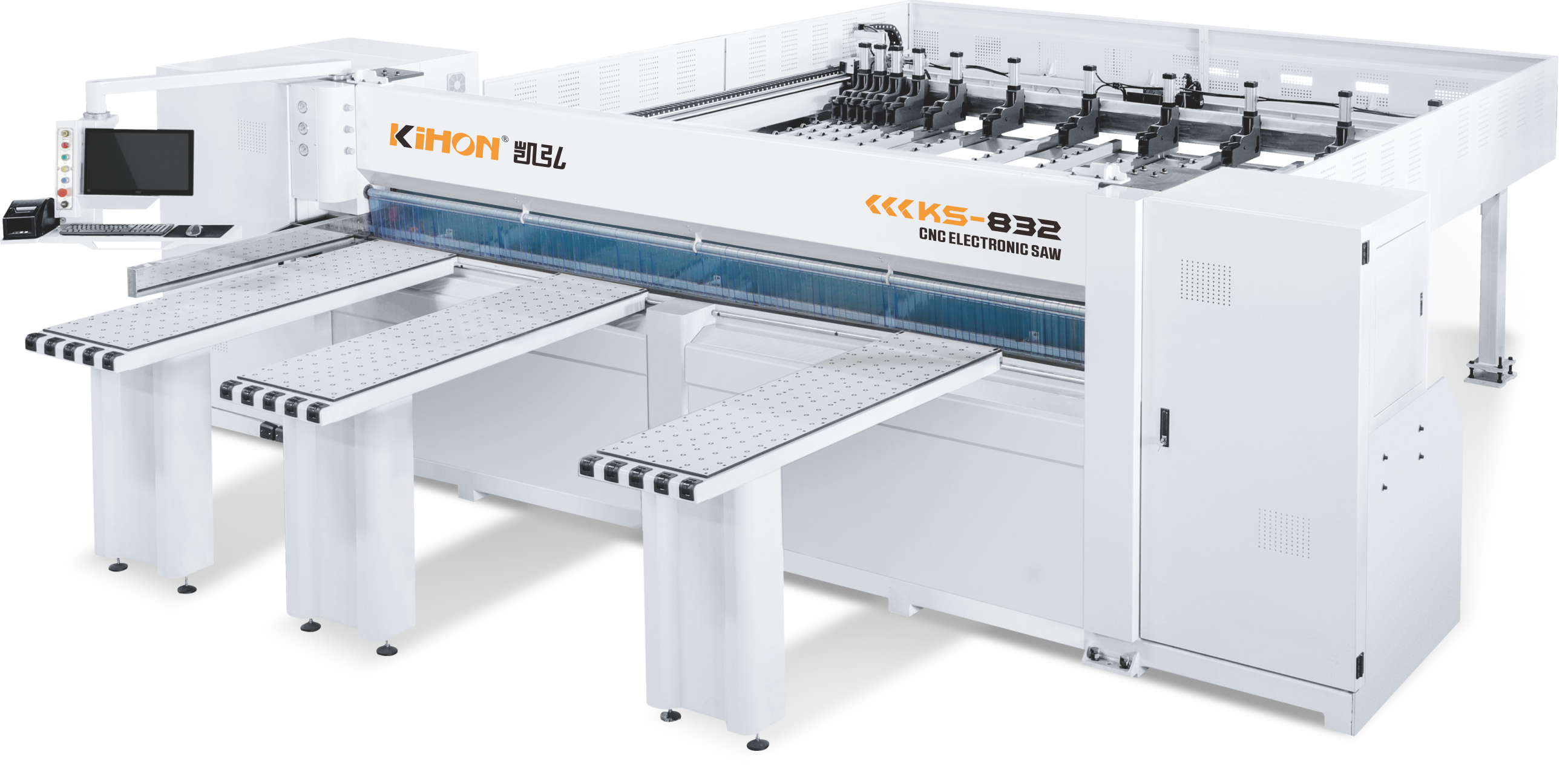
Transitioning to an industrial CNC Panel Saw shifts the operation from heavy manual labor to automated precision. By integrating programmable pusher fences, heavy-duty grippers, and algorithmic optimization software, factories stabilize daily output and eliminate human error. This guide breaks down the verifiable benefits, technical evaluation criteria, and implementation realities of adopting automated panel cutting for modern furniture production.
ROI Drivers: Financial return is generated primarily through material yield optimization, reduced labor dependency, and fast cycle times, rather than raw cutting speed alone.
Downstream Quality: Furniture saw precision directly dictates the success of subsequent operations; strict tolerances eliminate rework in edge banding and joinery.
Software Dependency: Hardware is only as effective as its control system; seamless CAD/CAM, nesting, and optimization software integration is non-negotiable for modern production efficiency.
Adoption Realities: Successful implementation requires proactive mitigation of facility constraints (dust extraction, footprint) and operator training curves.
The Operational Shift: Manual Sliding Saws vs. CNC Panel Saws
Defining the Production Bottleneck
Manual sliding table saws rely entirely on the physical endurance and spatial awareness of the operator. This dependency introduces hidden costs that scale linearly with production volume. Highly skilled operators are required to interpret cut lists, manually set rip fences, and physically push heavy laminated sheets through the blade. As fatigue sets in during a standard shift, the margin of human error increases, leading to dimensional inaccuracies and chipped edges. These micro-errors force downstream departments to compensate, slowing down edge banders and requiring manual rework on cabinet joints.
Establishing the success criteria for an equipment upgrade requires analyzing specific production thresholds. Facilities must evaluate their daily sheet consumption, the complexity of their cut patterns, and their current defect rates. When a factory exceeds the capacity of two manual sliding saws operating simultaneously, or when custom cut lists cause excessive setup downtime, upgrading to automated sizing becomes an operational necessity.
The Automation Advantage in Wood Sheet Cutting
The fundamental mechanics of a wood sheet cutting operation change drastically with automation. Instead of an operator physically guiding the material, a CNC saw utilizes programmable pusher fences equipped with heavy-duty pneumatic grippers. These grippers lock onto the material, advancing and retracting it through the cutting line with sub-millimeter accuracy. The saw carriage itself travels automatically along heavy steel guides, ensuring a perfectly straight and consistent feed rate regardless of material density.
This automated approach enables high-volume stack cutting. Operators can load multiple sheets of MDF or particleboard simultaneously, allowing the machine to process three or four panels in a single cutting cycle. Furthermore, modern equipment excels in batch-size-one manufacturing. The control software dynamically adjusts the pusher fences and cutting lengths for custom, individualized cut lists on the fly. This eliminates the need for operators to manually reset mechanical stops between different cabinet dimensions, ensuring continuous operation even during highly customized production runs.
Feature
Manual Sliding Table Saw
Automated Panel Saw
Material Handling
Manual pushing and alignment
Pneumatic grippers and programmable pushers
Cutting Capacity
Single sheet processing
Multi-sheet stack cutting
Accuracy
Dependent on operator skill
Sub-millimeter mechanical precision
Setup Time
High (manual fence adjustments)
Zero (software-driven adjustments)
Operator Fatigue
High risk of physical strain
Minimal (air-flotation tables assist loading)
![CNC Panel Saw]()
Core Benefits and Evaluation Dimensions of a CNC Panel Saw
Furniture Saw Precision and Downstream Impact
Achieving micron-level furniture saw precision is critical for processing sensitive materials like melamine, MDF, plywood, and high-pressure laminates. Automated sizing eliminates the stepping effect—a common defect where manual feed rates fluctuate, causing the blade to leave microscopic ridges along the cut edge. A perfectly square, clean cut directly correlates with the reduction of glue-line defects during subsequent edge banding. When panels are sized accurately, the edge bander's pressure rollers apply uniform force, resulting in a seamless, invisible joint that resists moisture and peeling.
Preventing tear-out on delicate veneered surfaces relies heavily on the synchronized main and scoring blade system. The scoring blade rotates in the opposite direction of the main blade, creating a shallow pre-cut on the bottom surface of the laminate. When the main blade follows through, it cuts without lifting or fracturing the brittle surface layer. Automated saws maintain exact alignment between these two blades, ensuring flawless edges on both the top and bottom of the panel.
Maximizing Production Efficiency and Throughput
Optimizing production efficiency requires minimizing non-value-added movements. Automated saws achieve drastic cycle time reductions through smart cutting path algorithms. The saw carriage only travels the exact length of the panel being cut, rather than completing a full stroke across the entire machine bed. Additionally, independent servo motors control the carriage travel speeds, allowing the blade to accelerate through thin materials and automatically slow down when encountering dense, stacked panels.
When comparing manual processing times against automated multi-sheet cutting, the speed metrics heavily favor automation. A single operator running an automated saw can process the equivalent volume of three manual operators. Continuous, automated operation stabilizes daily production quotas because machine cycle times are predictable and unaffected by operator fatigue. The machine dictates the pace of production, ensuring a steady flow of sized parts to the assembly floor.
Material Yield Optimization and Waste Reduction
Raw material costs represent a massive percentage of overhead in furniture manufacturing. Algorithmic optimization software plays a pivotal role in generating high-yield, complex cutting patterns. Instead of relying on an operator's intuition to nest parts on a sheet, the software mathematically calculates the most efficient layout, rotating parts and combining different jobs to utilize every square inch of the board.
The financial impact of reducing offcuts and scrap material is substantial over a fiscal year. By increasing material yield by just a few percentage points, high-volume factories save thousands of sheets of material annually. The software also manages offcut inventory, tracking reusable scrap pieces and prioritizing them for future cutting cycles, ensuring that nothing usable is discarded.
Versatility in Wood Processing and Material Diversity
Modern furniture lines frequently mix materials, requiring equipment that can transition seamlessly between engineered woods like MDF, particleboard, and OSB, as well as natural wood composites. Automated saws accommodate this diversity through programmable parameters. Operators adjust blade projection heights and carriage feed speeds directly from the control panel to match the specific density and thickness of the material being processed.
Variable blade speeds and material-specific blade geometries further enhance this versatility. Cutting dense laminates requires different rotational speeds and tooth configurations compared to cutting soft plywood. By utilizing quick-change blade systems and programmable RPM settings, the machine maintains optimal cut quality across a wide spectrum of material compositions without requiring lengthy setup changes.
Operator Safety and Ergonomic Improvements
Safety protocols are inherently stronger with automated machinery. The transition from hands-on-blade proximity to enclosed, automated cutting zones drastically reduces workplace accidents. Operators stand behind a safety perimeter, loading materials and monitoring the control screen while the machine executes the cuts under a heavy pressure beam. Safety light curtains and emergency stop perimeters immediately halt the machine if a worker breaches the active cutting zone.
Ergonomic improvements are equally important for long-term workforce health. Handling heavy sheets manually leads to severe repetitive strain injuries and back trauma. Automated saws utilize air-flotation tables at the loading and unloading zones. These tables force compressed air through specialized valves, creating a frictionless cushion that allows operators to slide heavy stacks of material into position with minimal physical exertion.
Technical Evaluation: What to Look for in a Panel Cutting Machine
Mechanical Rigidity and Component Quality
The foundation of any industrial panel cutting machine is its mechanical rigidity. Buyers must evaluate the machine frame, which should be constructed from heavy, stress-relieved steel to absorb high-frequency vibrations during continuous operation. The saw carriage must travel on heavy-duty linear guides driven by a precision rack-and-pinion system. This configuration prevents carriage deflection and ensures absolute parallelism over years of heavy use.
Independent main and scoring saw motors are critical for maintaining cut quality under heavy loads. Sharing a single motor via belts can lead to RPM drops when cutting dense stacks, causing the scoring blade to lose synchronization with the main blade. Independent motors ensure that both blades maintain their programmed speeds, delivering consistent torque and preventing blade stall during aggressive cutting cycles.
Software Integration, HMI, and Control Systems
Hardware capabilities are entirely bottlenecked by poor software integration. The machine's control system must offer native compatibility with standard cabinet design and ERP software. This allows the engineering department to generate cut lists and push them directly to the machine without manual data entry, eliminating transcription errors.
Evaluating the Human-Machine Interface is essential for daily operations. A robust interface provides real-time diagnostic capabilities, visual cut sequence simulations, and intuitive error reporting. Operators should be able to see a graphical representation of the cutting pattern on screen, highlighting exactly which part is being cut and where it belongs. Networked file transfer from the office to the machine is vastly superior to local optimization, as it centralizes production control and ensures the factory floor is always working from the latest design revisions.
Material Handling and Automation Upgrades
Facility layout and production volume dictate the ideal material handling configuration. Front-loading machines require operators to manually slide panels or use vacuum-assisted lifters to position sheets onto the air tables. This setup is suitable for mid-sized operations with space constraints. Rear-loading configurations feature automatic lift tables that accept entire bunks of material via forklift. The machine automatically lifts and feeds the required number of sheets into the cutting zone, drastically reducing forklift traffic and manual handling.
Optional efficiency add-ons further streamline the process. Integrated barcode labeling systems at the outfeed station print and apply labels to each cut part. These labels contain part dimensions, edge banding instructions, and routing programs, ensuring seamless tracking as the part moves through the factory. Scissor lifts and outfeed sorting conveyors help operators stack finished parts ergonomically, preventing bottlenecks at the unloading station.
Implementation Risks and Mitigation Strategies
Overcoming the Software and Operational Learning Curve
Transitioning from manual cutting to automated processing introduces a steep operational learning curve. Facilities face a high risk of production dips during the initial physical transition and calibration period. Operators accustomed to manual measurements must learn to trust the machine's interface, troubleshoot software errors, and manage digital cut lists.
Mitigating this risk requires structured operator training programs and comprehensive software onboarding. Management should schedule dry-run testing and process non-critical scrap material before decommissioning old machinery. Running the new automated saw in parallel with existing manual saws for a short overlap period ensures that daily production quotas are met while the workforce builds confidence and proficiency with the new control systems.
Maintenance Protocols and Downtime Prevention
Automated saws are highly reliable, but they introduce new points of failure not found in manual equipment. Common issues include sensor alignment faults, pneumatic seal wear, and linear guide contamination. If a proximity sensor fails or the pressure beam loses pneumatic pressure, the machine will halt production immediately to prevent damage.
Establishing strict preventative maintenance schedules is the most effective mitigation strategy. Operators must perform daily dust clearance routines, wiping down sensor lenses and blowing out the saw carriage compartment. Maintenance teams must adhere to automated lubrication schedules for the rack-and-pinion drives. Maintaining a critical spare parts inventory ensures that minor component failures do not result in days of costly machine downtime.
Conduct daily visual inspections of pneumatic lines and pressure gauges.
Clean optical sensors and safety light curtains at the end of every shift.
Verify automatic lubrication reservoirs are filled with the manufacturer-specified oil.
Inspect scoring and main blades for resin buildup and replace dull blades immediately.
Vacuum the internal carriage tracks to prevent dust compaction on linear guides.
Conclusion
Conduct a time-and-material audit of your current cutting process to identify exact waste percentages and labor hours spent on sizing.
Request a software integration test with the equipment manufacturer using your existing cabinet design library to verify seamless data transfer.
Measure your facility's available footprint, including required clearances for raw material staging and finished parts outfeed.
Schedule a live machine demonstration using your specific materials to validate cut quality, cycle times, and operator ergonomics.
FAQ
Q: What is the average ROI timeline for a CNC panel saw in a mid-sized shop?
A: Most mid-sized furniture manufacturers see a full return on investment within 18 to 24 months. This timeline is driven by immediate reductions in material waste through optimization software, lower labor costs by reallocating manual saw operators, and the elimination of downstream rework caused by inaccurate cuts.
Q: How does a CNC panel saw improve wood sheet cutting yield compared to nesting CNC routers?
A: Panel saws utilize straight-line cutting with thin-kerf blades, generating minimal waste between parts. Nesting CNC routers use router bits that consume more material per cut and require vacuum hold-down spacing between parts, making panel saws inherently more material-efficient for straight rectangular cuts.
Q: Can a panel cutting machine integrate with existing cabinet design and nesting software?
A: Yes, industrial control systems are designed to accept standard output files from major CAD/CAM and ERP software platforms. This allows seamless transfer of cut lists and optimization patterns directly from the engineering office to the machine without manual data entry.
Q: How does a scoring blade unit prevent chipping on laminated and veneered boards?
A: The scoring blade is positioned in front of the main blade and rotates in the opposite direction. It makes a shallow, precise cut through the bottom layer of the laminate. When the main blade cuts through the rest of the material, the brittle surface is already severed, preventing upward tear-out.
Q: What are the primary facility requirements for installing an industrial CNC panel saw?
A: Installations require a level, reinforced concrete floor, clean three-phase electrical power, a dedicated dry compressed air supply for pneumatics, and a high-capacity dust extraction system. Ample square footage is also needed for safe forklift access and material staging.
Q: What is the difference between front-loading and rear-loading panel saws, and which is better for high-volume production?
A: Front-loading requires operators to manually slide sheets onto the machine, suited for mid-volume shops. Rear-loading features an automated lift table that feeds sheets directly from a forklift-loaded bunk. Rear-loading is vastly superior for high-volume production as it eliminates manual lifting and accelerates cycle times.
Q: How does furniture saw precision affect the quality of downstream edge banding?
A: Edge banders require perfectly square, smooth edges to apply uniform pressure and heat. If a panel is cut with microscopic ridges or out-of-square angles, the edge banding will not adhere properly, leading to visible glue lines, peeling edges, and costly manual rework.

![English]()
![zhifufuben]()