-
- CNC Panel SawCNC Router MachineAutomatic Edge Banding MachineSix Sided CNC Drilling Machine
- Application

Edge Banding Machine vs Manual Edge Finishing
Views: 0 Author: Site Editor Publish Time: 2026-06-21 Origin: Site


The hidden profitability drain in custom and production woodworking often lies right at the edges. Specifically, the time and labor consumed by finishing raw panel edges can severely impact a shop's bottom line. When relying on manual application, balancing production speed with finish quality becomes increasingly difficult as order volumes grow. There is a distinct tipping point where the labor costs, rework, and inconsistencies of manual edge application begin to erode profit margins and delay delivery schedules.
To solve this, shop owners must evaluate an objective Edge Banding Comparison of manual application methods versus automated machinery. Understanding the operational differences helps determine the financially viable path based on production volume and quality standards. Upgrading from manual methods to automated systems requires careful consideration of capital expenditure, floor space, and material compatibility to ensure long-term profitability.
Manual finishing offers a near-zero barrier to entry but scales poorly, creating severe bottlenecks and labor dependencies in high-volume cabinet finishing.
Automated edgebanders drastically increase throughput and consistency but require significant upfront capital, dedicated floor space, and strict maintenance protocols.
Material compatibility varies significantly; industrial materials like thick PVC and ABS require machine application, while natural wood veneer and melamine can be applied manually with distinct durability trade-offs.
The break-even point for machinery investment hinges on the volume of linear feet processed weekly, the cost of local skilled labor, and acceptable rework thresholds.
Transitioning from manual to automated systems introduces new infrastructure demands—such as 3-phase power, compressed air, and dust collection—that must be factored into the total cost of ownership.
Defining the Success Criteria for Wood Panel Edging
Establishing baseline metrics is essential for evaluating edge finishing processes. Key performance indicators include linear feet processed per hour, acceptable rework or defect rates, and adhesive bond strength over time. These metrics provide a clear picture of how efficiently a shop operates and where bottlenecks occur during wood panel edging. You cannot improve what you do not measure. Tracking the exact minutes an operator spends ironing on tape, trimming the ends, and scraping the top and bottom edges reveals the true labor burden of manual methods.
Material versatility is another major factor. Different edge banding materials, such as PVC, ABS, natural wood veneer, and melamine, respond differently to various application methods. Heavy PVC and ABS generally require the high pressure and precise temperature control of an automated machine. Thin melamine or pre-glued veneer can be applied manually, though often with lower durability. When you switch from a standard 0.5mm melamine tape to a 3mm PVC edge for commercial casework, the application method must change. Manual application of 3mm PVC is nearly impossible to execute cleanly because the material requires heavy mechanical pressure to bond properly to the substrate.
The method chosen directly impacts the final product. Edge quality dictates overall cabinet finishing standards, client perception, and long-term durability. A well-applied edge resists heat, moisture, impacts, and peeling, ensuring the cabinetry maintains its appearance and structural integrity over years of use. If an edge starts peeling in a humid kitchen environment six months after installation, the callback costs will quickly wipe out any savings gained from using cheaper manual application methods.
To properly evaluate your current edging process, consider tracking the following metrics on your shop floor:
Total linear feet of edge banding applied per eight-hour shift.
Number of parts rejected or requiring rework due to chipped edges, loose glue joints, or uneven trimming.
Total labor hours dedicated solely to edge preparation, application, and final cleanup.
Cost of wasted edge banding material due to manual handling errors.
Frequency of customer callbacks related to edge delamination or moisture damage.
Manual Edge Finishing: Realities and Limitations
The Spectrum of Manual Methods
Manual edge finishing spans several techniques. Purely manual application involves applying pre-glued banding using heat from household irons or hot air edgebander guns. The operator then hand-feeds the material, manually trims the ends with a guillotine or snips, and finishes by hand scraping or sanding the edges. This process is highly labor-intensive and physically demanding. Operators often experience fatigue in their hands and wrists from the repetitive motion of applying heavy downward pressure with a hand scraper to flush the edge tape with the panel face.
Another option is the manual or portable tabletop bander. These semi-manual setups require the operator to manually feed the panel past a motorized roller that applies hot-melt glue. While this speeds up the gluing process, it still requires separate, manual post-trimming and finishing, keeping labor requirements high. The operator must carefully balance the panel as it moves past the glue roller. Any hesitation or uneven pressure results in a wavy glue line or a weak bond.
Strategic Advantages
Manual application has its place in certain scenarios. It requires virtually zero floor space and involves negligible capital expense, making it accessible for startups or hobbyists. Manual methods are also useful for one-off custom curves, complex radiuses, or low-wear applications where investing in specialized contour banding machinery isn't justified. If you are building a custom reception desk with a sweeping curved top, a portable hot-air bander allows you to follow the contour easily without needing a massive CNC contour machine.
Operational Disadvantages
The operational disadvantages of manual finishing become apparent as production scales. There is a high dependency on operator skill to achieve a clean finish. Inconsistent manual application pressure often leads to eventual delamination. Furthermore, severe limitations on production speed throttle shop output, creating significant bottlenecks in the assembly line. When the CNC router can cut fifty sheets of plywood in a day, but the edge banding station can only process ten sheets worth of parts, the entire production schedule backs up.
Material Constraints
Manual shops are mostly limited to thin melamine and pre-glued wood veneer. Applying heavy PVC, such as 2mm to 3mm thickness, or high-impact ABS manually is highly impractical. These thicker materials require the consistent heat and heavy roller pressure that only automated machines can provide to ensure a permanent bond. Attempting to iron on 3mm PVC usually results in the material warping from the uneven heat, and the manual pressure is never sufficient to compress the thick plastic against the wood core.
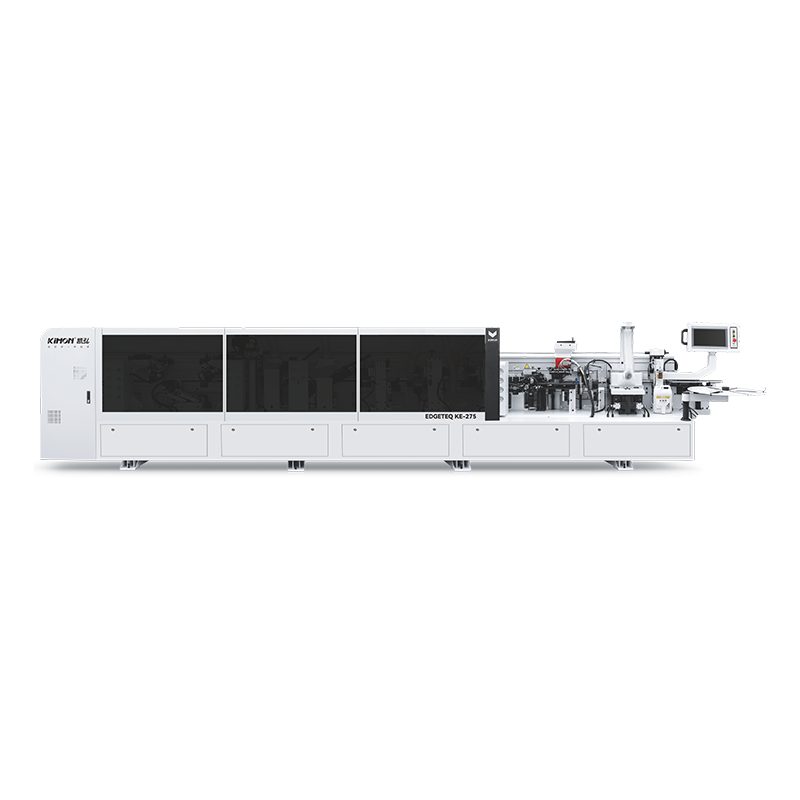
Edge Banding Machines: From Semi-Automatic to CNC
Categorizing the Equipment
Automated edgebanders come in various configurations. Split-station or modular setups combine a manual-feed bander with a separate, dedicated trimming and buffing station. Entry-level semi-automatic machines feature automated feed systems that glue, tape, and end-trim but may require manual intervention for fine corner rounding or scraping. These entry-level machines are often the first step up for a growing cabinet shop, providing a massive jump in speed over hand ironing.
Fully automatic and CNC edgebanders represent the top tier. These multi-station inline systems process panels from raw edge to finished, buffed product in a single pass, drastically reducing labor and handling time. A panel goes in one end raw and comes out the other end completely finished, ready for doweling or assembly.
Anatomy of Automation
A modern edgebander consists of sequential stations designed for specific tasks. Premilling units prepare the panel edge by shaving off a fraction of a millimeter to ensure a perfectly square, chip-free surface. Glue pots apply EVA or PUR adhesives precisely. Pressure rollers secure the banding. End-trimming saws cut the overhang flush with the leading and trailing edges. Top and bottom flush trimming units remove the excess width. Corner rounding stations profile the sharp corners, scraping units remove knife marks, and buffing stations clean off any residual glue and polish the edge.
Understanding the function of each station helps operators troubleshoot issues:
Premill Station: Uses diamond cutter heads to eliminate saw blade scoring marks and minor chipping from the panel sizing process.
Glue Application: A heated roller applies a precise film of adhesive to the panel edge just before the tape is introduced.
Pressure Zone: A large driven roller followed by smaller idle rollers compresses the tape into the glue, forcing out air pockets.
End Trimming: Precision saws travel with the panel momentarily to snip the front and rear tape overhang perfectly flush.
Top/Bottom Trimming: High-frequency motors with profiled cutters trim the top and bottom overhang, often leaving a slight radius or bevel.
Scraping: Profile scrapers remove the microscopic chatter marks left by the spinning trim cutters, smoothing the plastic edge.
Buffing: Cloth wheels spin at high speed to clean off glue squeeze-out and restore the color to the trimmed plastic edge.
Manual vs CNC Edge
When comparing manual vs cnc edge finishing, the differences are stark. Lower-tier methods rely heavily on operator-dependent feeding and manual adjustments. In contrast, CNC systems offer precision-controlled, high-throughput automation and programmable changeovers. An operator can switch from 0.5mm tape to 3mm tape by simply selecting a program on the touchscreen. The machine automatically adjusts the pressure rollers, trim motors, and scrapers to the new thickness, ensuring consistent quality across large production runs without relying on operator craftsmanship.
Comprehensive Edge Banding Comparison: Evaluating the Trade-Offs
Production Speed and Throughput Capabilities
A time-motion analysis reveals significant differences. Manually edging, flush-trimming, end-cutting, and scraping a standard cabinet part takes several minutes per piece. Automated machines operate at feed rates typically ranging from 30 to 80+ feet per minute, processing parts in seconds. A stack of drawer parts that would take an operator four hours to edge manually can be run through a high-speed edgebander in under twenty minutes.
This speed mitigates bottlenecks. Slow edge finishing causes assembly line delays, increasing the true cost of production. Automation synchronizes part flow, allowing the entire shop to operate more efficiently and take on larger projects. When parts flow smoothly from the saw or router directly through the edgebander and into assembly, you eliminate the massive staging areas required to hold work-in-progress inventory.
Quality, Consistency, and Durability
Adhesive application dictates bond longevity. Pre-applied iron-on adhesives often fail under heat or moisture. Automated machines use uniform, high-pressure application of precision hot-melt glue rollers with EVA or chemical-resistant polyurethane (PUR) adhesives, creating a far superior and longer-lasting bond. PUR glue, in particular, undergoes a chemical cross-linking process as it cures, making the bond highly resistant to heat and water. This is a massive advantage for kitchen and bathroom cabinetry.
Trimming accuracy also improves. Automation eliminates human error in flush cutting and corner rounding. This results in a factory-grade finish without gouging the panel face, enhancing the overall aesthetics and perceived value of the cabinetry. Hand trimming often results in accidental scratches on the melamine face or uneven bevels. A machine with properly calibrated tracing shoes rides perfectly along the panel surface, delivering a flawless cut every single time.
Financial Trade-Offs: Labor Costs vs. Capital Expenditure (CapEx)
Calculating ROI requires comparing ongoing hourly wages, overtime, and labor scarcity against machine depreciation and financing costs. While the initial investment for a machine is high, the reduction in labor hours often justifies the expense for growing shops. If you are paying an employee full-time just to apply edge banding manually, the monthly cost of that labor easily exceeds the monthly finance payment on a high-quality automated machine.
Hidden costs must also be weighed. Manual rework, operator fatigue, and wasted edge band materials add up quickly. These must be compared against machine maintenance, tooling replacement, and consumable costs like granule glue and cleaning agents. Automated machines require regular maintenance, including cleaning the glue pot, replacing dull cutter heads, and lubricating pneumatic cylinders. However, the predictability of these maintenance costs is far easier to manage than the unpredictable costs of human error and fatigue.
DECISION MATRIX FOR CABINET SHOPS
Feature / Metric
Manual Edge Finishing
Automated Edge Banding Machine
Primary Materials
Thin veneer, melamine, pre-glued PVC
PVC (0.4–3mm), ABS, Wood Veneer, Acrylic
Adhesive System
Pre-applied hot-melt (iron-on)
Bulk granules/cartridges (EVA or PUR)
Production Speed
Very Low (~1–3 parts per minute)
High (30 to 80+ Feet Per Minute feed)
Labor Dependency
High (requires skilled hands)
Low (requires machine operator)
Edge Durability
Moderate to Low (peeling risk)
High (factory-grade bond, water-resist)
Floor Footprint
Minimal / Portable
Substantial (10 to 25+ feet long)
Implementation Risks and Shop Floor Realities
Upgrading to automated machines requires specific infrastructure. Shops need 3-phase power, high-CFM dust collection, and clean, dry, compressed air systems to operate these machines effectively. Failing to provide adequate infrastructure leads to poor machine performance and frequent breakdowns. If your compressed air system has moisture in the lines, it will destroy the pneumatic valves inside the edgebander. If your dust collection is inadequate, PVC shavings will build up on the tracing shoes, causing the trim routers to gouge the panels.
Operator training is a reality. The learning curve shifts from manual craftsmanship to machine calibration, glue pot maintenance, and troubleshooting common defects like snipe, chatter marks, or glue squeeze-out. Proper training is essential to maximize the machine's capabilities. An operator must learn how to read the glue line. Too much glue causes a messy squeeze-out that fouls the buffing wheels. Too little glue results in a weak bond that will fail in the field. Adjusting the dosing gate on the glue pot requires a precise understanding of the machine's mechanics.
Space and workflow constraints are significant. The physical footprint of an automatic edgebander is substantial. Shops must factor in the machine length plus the required infeed and outfeed clearance for processing large 4x8 or 5x10 panels safely and efficiently. You cannot place an edgebander tight against a wall if you expect to run eight-foot tall pantry end panels through it. You need adequate swing room for the operator to load and unload the parts without damaging them.
Conclusion
Conduct a detailed time study on your current manual edging process to determine your exact labor cost per linear foot.
Calculate your weekly linear footage requirements to see if you have crossed the 150-200 panel threshold that justifies automation.
Evaluate your shop floor space, ensuring you have the necessary room for the machine footprint plus infeed and outfeed clearance.
Verify your shop's infrastructure, specifically checking for available 3-phase power, adequate dust collection CFM, and a dry compressed air supply.
Request physical sample runs from equipment dealers using your own specific edgeband materials and core panels to verify machine performance before purchasing.
FAQ
Q: At what production volume should a shop upgrade to an edge banding machine?
A: A shop should consider upgrading when processing around 150-200 panels per week. At this volume, the labor hours spent on manual edging create significant bottlenecks, making the ROI on an automated machine highly favorable based on linear feet processed.
Q: What is the difference in durability between manual iron-on banding and machine-applied PUR glue?
A: Machine-applied PUR glue offers superior heat and moisture resistance compared to manual iron-on adhesives. PUR creates a cross-linked chemical bond, providing near zero-joint technology and exceptional longevity on substrates like melamine and plywood.
Q: Can a CNC edgebander handle curved or custom-shaped wood panel edging?
A: Straight-line CNC edgebanders are designed for flat edges. For curved or custom shapes, shops use specialized CNC contour banders or hand-held portable units designed specifically to navigate complex radiuses.
Q: Can you process different materials like ABS, PVC, and wood veneer on the same machine?
A: Yes, modern automated edgebanders can process various materials. This requires material changeovers, adjusting thickness settings, and swapping scraping or trimming knife profiles to match the specific banding material.
Q: How much floor space is realistically required for a fully automatic edgebander?
A: A fully automatic edgebander requires substantial space. You must account for the machine's length plus adequate infeed and outfeed safety zones, typically requiring at least 8 to 10 feet of clearance on both ends for handling large panels.
Q: What are the most common maintenance issues with edge banding machines?
A: Common maintenance issues include glue pot carbonization, dull trimmer blades, empty cleaning agent reservoirs, and pneumatic sensor faults. Regular cleaning and scheduled maintenance are crucial to prevent these problems.
Q: Does transitioning from manual vs cnc edge finishing require specialized operator training?
A: Yes. The skill set shifts from manual hand-skills to machine operation. Training focuses on machine calibration, monitoring glue-pot temperatures, adjusting pressure stations, and performing routine scheduled maintenance.