-
- CNC Panel SawCNC Router MachineAutomatic Edge Banding MachineSix Sided CNC Drilling Machine
- Application
![news]()
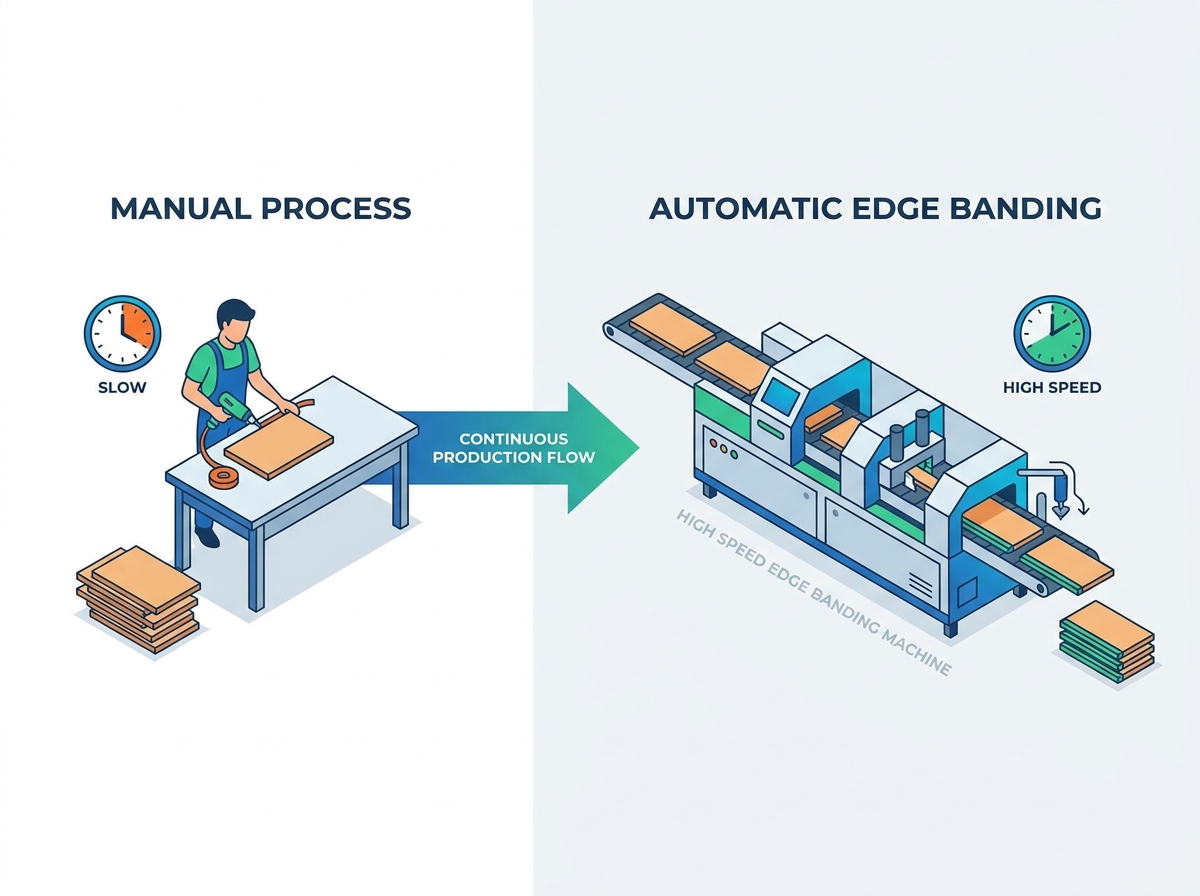
Automatic Edge Banding for Continuous Panel Furniture Production
Views: 0 Author: Site Editor Publish Time: 2026-08-27 Origin: Site
![facebook sharing button]()
![twitter sharing button]()
![line sharing button]()
![wechat sharing button]()
![linkedin sharing button]()
![pinterest sharing button]()
![whatsapp sharing button]()
![sharethis sharing button]()
In continuous panel furniture manufacturing, the edge banding station acts as the primary chokepoint determining production throughput and final product quality. Relying on outdated or mismatched equipment leads to visible glue lines, moisture vulnerability, panel warping, and edge peeling. These defects disrupt automated workflows and compromise the structural strength of finished cabinets or desks. Selecting the right industrial-grade Automatic Edge Banding Machine requires moving beyond basic specification sheets. You must evaluate glue application technologies, processing station configurations, and integration capabilities for continuous production environments. A well-configured setup eliminates manual rework, reduces material waste, and ensures every panel meets strict durability standards. We will break down exactly how to configure these systems for maximum uptime, flawless edge quality, and seamless integration into your existing factory floor.
Transitioning to a high speed edge banding machine requires aligning feed rates (often exceeding 25m/min) with the correct adhesive technology (EVA, PUR, or zero-joint/laser) to maintain finish quality and prevent moisture ingress.
The configuration of processing stations—specifically feeding, pre-milling, corner rounding, and polishing—dictates the machine's ability to produce seamless, durable edges on diverse materials.
Integrating a panel furniture edge bander into a continuous line demands evaluation of software compatibility, automated panel return systems, and compact layout strategies.
Success Criteria for High-Volume Panel Furniture Edge Banding
Establishing accurate production baselines is the first step in configuring an edge banding line. You need to define your required daily throughput accurately. High-volume production demands absolute consistency across thousands of linear meters. You cannot rely on manual adjustments to maintain this consistency. The machine must hold tight tolerances shift after shift. To establish a reliable baseline, you must calculate specific operational metrics before selecting equipment.
Calculate your daily linear meter requirements based on peak production shifts.
Identify the minimum and maximum panel dimensions your facility processes.
Determine the required edge tape thickness variations, typically ranging from 0.4mm melamine to 3mm PVC.
Assess the ambient humidity and temperature of the final installation site for the furniture.
Define the acceptable rework percentage for your production line to set quality control limits.
Evaluate the necessity of invisible glue lines versus standard commercial finishes. Zero-joint finishes meet premium market expectations. They eliminate the dark line often seen between the panel and the edge tape. Standard commercial finishes work perfectly for budget furniture lines or hidden cabinet components. The edge band acts as a vital protective layer. It seals the porous core of the panel. This seal prevents warping caused by ambient air humidity. It also protects the core from physical impacts during transport and daily use.
Assess the machine's ability to handle various edge profiles. Standard straight edge banding covers the majority of panel processing needs. Specialized processes require different mechanical setups. Soft-forming applies edge tape to profiled panel edges. Post-forming wraps laminate over a machined radius. Some custom components require integration with manual curved edge banders. Your primary straight-line machine must handle the bulk of the volume to free up operators for these custom tasks. If your production mix includes J-pull cabinet doors or handle-less profiles, you need specialized pressure zones and contour trimming units.
Material versatility dictates operational flexibility. You must seamlessly switch between different edge tape materials. PVC, ABS, wood veneer, and melamine all possess different physical properties. They require specific pressure settings and trimming tool geometries. Panel cores also vary significantly. Medium-density fiberboard (MDF) provides a smooth surface for gluing. Particleboard contains voids that require optimal glue spread to ensure adhesion. Plywood presents layered edges that demand sharp pre-milling tools to prevent splintering. Honeycomb lightweight panels require specialized support rollers to prevent crushing the core during the pressing phase.
Determine your adhesive requirements based on the furniture's end-use environment. Kitchen and bathroom cabinets demand high moisture resistance. They face constant exposure to steam and water spills. Office furniture requires high heat resistance to withstand direct sunlight near windows. The structural stability of the furniture relies heavily on the bond strength at the edge. Selecting the wrong adhesive compromises the entire panel, regardless of the core material quality. A weak bond leads to delamination, which ruins the aesthetic and structural integrity of the finished product.
Core Technologies and Processing Stations Evaluated
Panel Feeding and Top Pressure Systems
Panel feeding requires absolute precision. Robust, vibration-free feeding tracks form the foundation of the machine. Heavy-duty steel frames absorb the vibrations generated by high-speed milling and trimming motors. The feed track typically consists of a heavy chain with high-friction rubber pads. Motorized top pressure beams prevent panel shifting during transit. They utilize either staggered rubber rollers or continuous V-belts. Continuous V-belts provide superior grip for delicate or high-gloss panels. These systems ensure perfect alignment at high feed speeds. Encoder feedback systems monitor the panel position continuously. They trigger the subsequent processing stations at the exact millisecond required, ensuring tools engage and disengage perfectly with the leading and trailing edges.
Adhesive Application Systems: EVA vs. PUR vs. Laser
Ethylene Vinyl Acetate (EVA) remains a cost-effective, standard application choice. It suits general-purpose furniture perfectly. EVA comes in granular form and melts quickly in the glue pot. It applies easily via a heated roller. However, EVA remains vulnerable to high heat and moisture. It can reactivate if exposed to high temperatures, causing the edge tape to peel. It also leaves a visible glue line, which can collect dirt over time.
Polyurethane (PUR) offers superior bonding strength. It undergoes a chemical cross-linking process as it cures with ambient moisture. This makes PUR highly water and heat resistant. PUR creates a much thinner glue line, improving the aesthetic finish. It requires strict cleaning protocols. Operators must purge the system with specialized cleaning agents to prevent the glue from curing inside the applicator or the melting unit. PUR also demands humidity-controlled storage for the unsealed adhesive, often utilizing nitrogen-pressurized melting tanks.
Zero-joint, hot-air, or laser technology eliminates the traditional glue pot entirely. These systems melt a pre-applied functional polymer layer directly on the edge band using a high-powered laser or compressed hot air. This technology offers the highest aesthetic quality available. It creates a truly seamless transition between the panel and the edge. It eliminates glue residue on the panel surface entirely. However, it demands a significant premium in machine technology and specialized consumable costs.
Adhesive Technology Comparison
Adhesive Type
Bond Strength
Moisture Resistance
Glue Line Visibility
Maintenance Needs
EVA (Ethylene Vinyl Acetate)
Moderate
Low to Moderate
Visible (0.1mm - 0.2mm)
Low (Standard scraping and cleaning)
PUR (Polyurethane)
Very High
Excellent (Waterproof)
Minimal (Nearly invisible)
High (Requires strict purging protocols)
Laser / Hot-Air
High
Excellent
Invisible (True zero-joint)
Low (No glue pot to clean)
Pre-Milling and Edge Preparation
The pre-milling station prepares the panel edge immediately before glue application. It utilizes dual counter-rotating diamond cutterheads (PCD tooling). One motor climb-cuts the leading edge while the second motor conventional-cuts the trailing edge. This jump-in/jump-out setup eliminates panel blowout and chipping on both ends. It squares the edge perfectly, removing any imperfections, scoring marks, or swelling left by the panel saw. Evaluate the spindle power carefully. Dense materials like compact laminate or thick plywood require high torque to maintain a clean cut without bogging down the motors. Dust extraction efficiency at the pre-milling station is critical. Any dust or wood chips left on the panel edge will mix with the adhesive, creating lumps and severely weakening the bond.
Pressing, End-Cutting, and Trimming Configurations
The pressing zone bonds the tape to the panel immediately after the glue roller. Pneumatic pressing rollers apply uniform pressure along the edge. The first roller is usually large in diameter, driven by the machine, and applies the primary bonding force. Subsequent idle rollers feature alternating conical tapers. They squeeze the tape tightly against the top and bottom edges of the panel. This prevents tape distortion, closes the glue line tightly, and ensures a smooth edge finish. The pneumatic pressure must be adjustable to accommodate delicate hollow-core panels versus dense MDF.
High-speed end cutting removes the excess tape overhang at the front and rear of the panel. This station utilizes dual-motor linear guide systems. The motors travel alongside the panel momentarily to execute a precision chop cut without stopping the feed track. Pneumatic cylinders control the rapid movement of the saw blades. Clean, dry compressed air is essential for the accuracy of this station. Any moisture in the air lines will cause the pneumatic valves to stick, resulting in angled cuts or damaged panels. Advanced end-cutting units can tilt automatically to provide a slight chamfer cut on thick PVC tapes.
Rough and fine trimming stations remove the top and bottom tape overhang along the length of the panel. Rough trimming removes the bulk of the material, leaving a slight overhang. Fine trimming utilizes multi-profile carbide tools to create a flush cut, a slight bevel, or a specific radius (e.g., 2mm or 3mm). Modern machines utilize servo-controlled axes to switch between different edge thicknesses automatically. The operator selects the tape thickness on the control screen, and the servo motors move the trimming units into the exact position. This eliminates manual mechanical adjustments, drastically reducing changeover times between different production batches.
Corner Rounding and Final Polishing
Corner profiling finishes the sharp corners left by the end-cutting saws on thick edge bands. Multi-motor corner rounding units process post-formed panels and complex geometries. High-frequency motors follow the contour of the panel using precision copying shoes. Advanced units utilize four distinct motors to handle the leading top, leading bottom, trailing top, and trailing bottom corners independently. This allows the machine to process panels at high speeds without slowing down the feed rate. The kinematics of these units must be perfectly tuned to prevent gouging the panel surface while maintaining a smooth radius on the tape.
Scraping and buffing stations provide the final finish. Radius scrapers remove the microscopic chatter marks left by the rotary fine trimming tools. They shear off a tiny ribbon of plastic to create a perfectly smooth, glass-like radius. Flat scrapers remove any excess glue squeezed out onto the panel surface during the pressing phase. Oscillating buffing wheels polish the machined edges. They utilize heavy cotton cloth wheels and automated spraying units that apply liquid cleaning agents. This process removes any remaining adhesive residue, restores the original color and sheen to the plastic edge tape, and leaves the panel ready for immediate packaging.
![Automatic Edge Banding Machine processing panel furniture]()
Sizing a High Speed Edge Banding Machine for Your Facility
Analyzing the relationship between track speed and finish quality is essential. A standard entry-level machine might run at 12 to 18 meters per minute. A true high speed edge banding machine operates at 25 to 30 meters per minute or faster. Higher speeds require longer station engagement times. The glue needs sufficient time to cure under pressure before the panel hits the trimming stations. The corner rounding motors need time to track the panel profile accurately without bouncing. You cannot simply increase the feed track speed without upgrading the processing stations to match. Flawless finishes depend on the correct synchronization of speed, pneumatic pressure, and tooling engagement.
Map the physical space required on your factory floor. Prioritize compact layout designs, but never sacrifice operational clearances. A fully loaded industrial machine can measure between 7 and 10 meters in length. You must allow sufficient space for panel loading and unloading. Long panels, such as wardrobe doors or conference tabletops, require significant infeed and outfeed support rollers. Maintain clear access aisles for maintenance personnel. Technicians need room to open the heavy safety hoods, extract glue pots for cleaning, and replace heavy milling tooling. A cramped layout leads to safety hazards, damaged panels, and prolonged downtime during routine tool changes.
Evaluate your facility's capacity to supply stable utilities. Pneumatic cylinders drive the pressing rollers, end-cutting saws, and copying shoes. You need a stable, high-volume supply of dry, compressed air, typically maintaining a constant 6 to 8 bar of pressure. Pressure drops in the pneumatic lines will cause the end-cutting saws to miss their target, ruining the panel. Industrial three-phase power is mandatory to run the multiple high-frequency motors and the glue heating elements simultaneously. Ensure your dust collection system provides adequate cubic feet per minute (CFM) and maintains an air velocity of at least 30 meters per second at the extraction ports to clear the heavy plastic shavings generated by the trimming and scraping stations.
Integrating a Panel Furniture Edge Bander into Automated Lines
Determine when to utilize continuous double-sided edge banders versus flexible single-sided units. Double-sided machines process two parallel edges simultaneously. They excel at high-volume, symmetrical panel processing. They are ideal for standardized cabinet components, drawer fronts, and shelving units. However, they require significant setup time for width adjustments if not fully servo-driven. Flexible single-sided units handle mixed batches much better. They adapt quickly to varying panel sizes, custom orders, and complex routing patterns. Many facilities utilize a double-sided line for their core cabinet boxes and a high-spec single-sided machine for custom fronts and specialized materials.
A four-machine edge banding line represents the peak of automated square-edge processing. This architecture utilizes four single-sided machines connected by automated turning devices and roller conveyors. The panel travels through the first machine to band the first edge. A turning cone or cross-transfer conveyor rotates the panel 90 degrees. It enters the second machine for the adjacent edge. This continues until all four edges are sealed. This setup enables zero-touch processing. It delivers extremely high productivity within a relatively compact footprint, eliminating the need for operators to manually rotate and re-feed heavy panels.
Integrating a panel furniture edge bander with automated panel return systems drastically reduces labor requirements. Rotary return conveyors catch the panel at the outfeed. They transport it back to the operator at the infeed station via air-cushion tables and driven belts. This enables a highly efficient single-operator workflow. It also minimizes manual handling damage. Operators no longer need to carry heavy panels across the factory floor or slide them over rough surfaces. Scissor lifts at the infeed and outfeed can further automate the process by keeping the panel stacks at an ergonomic working height.
Evaluate software compatibility and factory integration. Modern machines feature advanced barcode scanning capabilities. The operator scans the panel label, and the machine downloads the processing parameters automatically from the central server. Servo motors adjust the top pressure beam height, the guide fence position, and the trimming tool profiles instantly based on the barcode data. This eliminates human error during setup and allows for true batch-size-one production. Integration with factory manufacturing execution systems (MES) or Enterprise Resource Planning (ERP) software keeps production data visible. Managers can track throughput, edge tape consumption, adhesive usage, and machine status in real time, allowing for accurate production scheduling and inventory management.
Automated Line Configuration Comparison
Configuration Type
Best Use Case
Labor Requirement
Flexibility
Standalone Single-Sided
Custom shops, mixed batches
2 Operators (Infeed/Outfeed)
Very High
Single-Sided with Return System
Mid-to-high volume custom production
1 Operator
High
Double-Sided Line
Standardized cabinet components
2-3 Operators
Low to Moderate
Four-Machine Automated Line
Mass production, zero-touch processing
1-2 Operators (Supervisory)
Moderate
Conclusion
Audit your current daily linear meter requirements and panel size variations to determine the exact baseline feed speed needed for your new equipment.
Compile a matrix of your specific core materials and edge tapes to request customized test runs from shortlisted vendors.
Inspect the test panels physically to verify glue line thickness, edge smoothness, and corner rounding accuracy before making a final selection.
Map your factory floor space to ensure adequate clearance for automated panel return systems, infeed rollers, and maintenance access hoods.
Upgrade your facility's pneumatic and dust collection systems to meet the specific CFM and constant bar pressure demands of the new processing stations.
FAQ
Q: What is the difference between EVA and PUR in an automatic edge banding machine?
A: EVA is a standard, cost-effective hot-melt adhesive suitable for general furniture. It can reactivate under high heat. PUR undergoes a chemical moisture cure, creating a much stronger, heat-resistant, and highly waterproof bond. PUR produces a thinner, less visible glue line but requires strict cleaning and purging protocols to prevent the glue from hardening permanently inside the machine.
Q: How fast can a high speed edge banding machine operate without losing quality?
A: Industrial high-speed machines operate at feed rates between 25m/min and 35m/min. Maintaining quality at these speeds requires heavy-duty steel frames to absorb vibration, rapid servo-controlled station adjustments, and extended pneumatic pressing zones to ensure the adhesive cures properly before the panel reaches the trimming units.
Q: What is a pre-milling station on a panel furniture edge bander?
A: The pre-milling station sits just before the gluing unit. It uses dual counter-rotating diamond cutterheads to trim a fraction of a millimeter off the panel edge. This removes saw blade scoring marks, eliminates edge chipping, and provides a perfectly square, clean surface for the adhesive, ensuring a flawless and tight bond.
Q: Can one machine handle PVC, ABS, and wood veneer edge banding?
A: Yes, modern machines handle multiple materials using flexible station setups. PVC and ABS require specific profile scraping and buffing to restore their finish. Wood veneer is brittle and requires careful handling at the end-cutting and trimming stations to prevent splintering. Servo-controlled axes allow the machine to switch between these material profiles automatically.
Q: What is the difference between straight, soft-forming, and post-forming edge banding processes?
A: Straight edge banding applies flat tape to a square panel edge. Soft-forming applies tape to a machined, contoured edge profile, requiring specialized pressure rollers to press the tape into the curves. Post-forming involves wrapping a surface laminate over a rounded panel edge, typically used for seamless countertops and specialized cabinet doors.
Q: How do automated panel return systems improve edge banding efficiency?
A: Automated return systems use conveyors and air tables to transport the finished panel from the machine's outfeed back to the infeed operator. This allows a single operator to feed and receive panels continuously. It eliminates the need for a second worker at the outfeed, reduces physical fatigue, and prevents edge damage caused by manual stacking.

![English]()
![zhifufuben]()