-
- CNC Panel SawCNC Router MachineAutomatic Edge Banding MachineSix Sided CNC Drilling Machine
- Application
![news]()
How Can a No-Clean PUR Glue Pot Reduce Changeover Time?
Views: 0 Author: Site Editor Publish Time: 2026-10-01 Origin: Site
![facebook sharing button]()
![twitter sharing button]()
![line sharing button]()
![wechat sharing button]()
![linkedin sharing button]()
![pinterest sharing button]()
![whatsapp sharing button]()
![sharethis sharing button]()
Are you tired of losing hours of valuable production time to messy, frustrating glue pot maintenance? If you manage a bustling shop floor, you already know the nightmare scenario. The Friday afternoon rush hits, and suddenly production stops. Your operators are forced into the tedious chore of draining, flushing, and scraping hardened adhesive. It kills your throughput and destroys your weekend schedule.
Traditional Polyurethane adhesives deliver an undeniably superior bond for modern cabinetry. However, their moisture-curing nature demands rigorous cleaning protocols. If you leave the glue exposed to ambient air, it cross-links and turns into a rock. Fortunately, a modern no-clean system solves this operational bottleneck entirely.
In this comprehensive guide, we will explore exactly how this innovative technology works on the shop floor. You will discover how it drastically cuts down changeover times, debunks common maintenance myths, and ultimately helps you optimize your manufacturing workflow.
Key Takeaways
Significant Time Savings: Advanced glue pot designs reduce daily maintenance and adhesive color changeovers from hours to mere minutes.
Zero Curing Risks: Sealed and nitrogen-purged environments effectively prevent ambient moisture from cross-linking and curing the adhesive inside the pot.
Cost Efficiency: This technology minimizes the continuous need for expensive flushing agents and drastically reduces adhesive waste during shift changes.
Superior Output Quality: Consistent glue application is maintained, which is essential for producing high-end, water-resistant panel edges.
Seamless Integration: Modern manufacturing equipment now incorporates intelligent no-clean systems to support heavy-duty, high-speed production schedules.
Understanding the PUR Edge Banding Machine and Glue Pot Mechanics
To fully grasp the operational advantages of modern adhesive systems, it is necessary to first understand the baseline technology. A PUR edge banding machine represents the current gold standard in the furniture and cabinetry manufacturing sector. Unlike legacy machinery that relies on Ethylene Vinyl Acetate hot melt glues, PUR-specific equipment is uniquely engineered to handle the complex chemical properties of polyurethane.
The fundamental difference between standard hot melts and PUR lies in their chemical curing processes. Standard glue simply solidifies as it cools, which is a completely reversible physical change. PUR behaves differently because it is a reactive adhesive. Although applied as a heated liquid at around 130 to 150 degrees Celsius, it undergoes a permanent chemical cross-linking process when exposed to moisture in the surrounding air.
Once this chemical reaction takes place, the adhesive creates an unbreakable, heat-resistant, and water-resistant bond. Because the curing process fundamentally alters the molecular structure of the glue, it cannot be remelted. This exact chemical property makes polyurethane superior for structural bonding. Consequently, it is also what makes it notoriously difficult to manage within a standard open-air hopper.
Industry Perspectives on Adhesive Automation
Looking at current manufacturing trends, the woodworking industry is experiencing a severe shortage of skilled machine operators. Simultaneously, there is a surging consumer demand for bespoke, high-end cabinetry with flawless zero-joint finishes. Facility managers are aggressively shifting their capital investments toward self-maintaining equipment to bridge this gap.
Automating routine maintenance is no longer just a luxury. It has become a critical strategy to maintain throughput despite leaner workforce numbers. The market demand for true moisture resistant panel edge banding means shops cannot simply revert to easier-to-manage glues. Instead, they must adopt intelligent machinery that handles the environmental control autonomously, lifting the burden of manual maintenance off the operator's shoulders.
![Special edge banding machine for aluminum honeycomb crawler conveyor]()
The Hidden Costs of Traditional PUR Glue Pot Maintenance
For facilities operating standard equipment, managing polyurethane introduces substantial hidden costs. The primary bottleneck is the rigorous daily maintenance required to prevent the adhesive from permanently rock-hardening inside the machine's internal components.
In a conventional setup, exposing the glue to ambient air means the curing process begins the second the lid is opened. If the line needs to be shut down for the night, or if an operator must switch from white to clear adhesive, a strict and exhausting cleaning protocol kicks in.
Operators must first drain the remaining active liquid from the pot. Next, they introduce a specialized chemical flushing agent into the system. The machine must then be cycled to push the neutralizer through the application rollers and internal lines, effectively forcing out the reactive glue. Finally, operators find themselves manually scraping the interior of the pot with a putty knife to remove residual charring. This manual labor is hazardous, unpleasant, and highly susceptible to human error.
Furthermore, the financial impact of this traditional maintenance extends far beyond the recurring cost of chemical cleaning agents. The true expense is buried in machine downtime and crippled production capacity. If a color changeover or an end-of-shift shutdown takes 45 to 60 minutes, that is nearly an hour of lost panel processing per day. If a facility values its edge banding line time at 150 dollars per hour, losing just four and a half hours a week equates to 675 dollars in lost revenue weekly. This staggering calculation ignores the cost of the wasted adhesive flushed away into the trash bin.
What is a No-Clean PUR Glue Pot Edge Bander?
To resolve these inherent mechanical bottlenecks, engineers developed the no-clean PUR glue pot edge bander. This technology fundamentally rewrites how adhesive is stored and melted at the application site. It completely isolates the glue from the catalyst that causes it to cure, which is atmospheric humidity.
A no-clean system utilizes a hermetically sealed melting chamber. Unlike traditional open-top hoppers where ambient shop air flows freely over the molten glue, a sealed pot blocks out all external environmental factors. Specifically, the interior walls of these advanced pots are treated with industrial-grade, non-stick Teflon coatings. This ensures that even as the adhesive cools and its viscosity increases, it will not permanently bond to the metal surfaces of the chamber.
The most critical component of this advanced setup is the atmospheric control within the pot itself. Top-tier machines utilize an active nitrogen purge system. Because nitrogen is a dry and inert gas, injecting a continuous low-pressure layer of it into the sealed chamber actively displaces any lingering oxygen and humidity. Without moisture, the chemical cross-linking reaction is completely halted. The adhesive remains in a stable liquid state while heated and safely transitions into a dormant solid state when the machine is powered down.
Feature
Traditional Open-Air Pot
Nitrogen-Purged No-Clean System
Daily Maintenance
45-60 minutes of draining, flushing, and scraping.
Zero daily flushing. Simply power down the heating elements.
Color Changeover
Requires full chemical purge to prevent pigment mixing.
3-5 minutes via quick-release modular sealed cartridges.
Material Waste
High. Unused glue is flushed out and discarded daily.
Near zero. Glue remains safely dormant inside the pot overnight.
Curing Risk
Extreme. Any exposure to shop humidity initiates cross-linking.
Eliminated. Inert nitrogen gas displaces all reactive moisture.
How a No-Clean System Drastically Reduces Changeover Time
Implementing a sealed, inert environment translates directly into measurable operational efficiency. By eliminating the constant threat of accidental curing, operators can bypass the most grueling steps of machine management.
In custom furniture manufacturing, switching between white, black, and natural adhesives is a daily reality. With older machinery, a color change requires a full purge to prevent pigment contamination. This process halts production for nearly an hour. In stark contrast, a no-clean system utilizes interchangeable sealed cartridges or modular pots. When a new color is needed, the operator simply disengages the current sealed pot, places it in a dry-storage docking station, and clicks the new color unit into place. The physical swap takes mere minutes. Production resumes the moment the new pot reaches its target application temperature.
The end-of-shift routine is where operators experience the most immediate relief. Instead of initiating a frantic flushing protocol, the operator simply turns off the heating elements and engages the sealing valve. The glue safely cools inside the pot. The next morning, the operator powers on the machine, the glue remelts within 15 to 20 minutes, and panel processing begins without delay.
Common Misconceptions About PUR Adhesives and Maintenance
Because early generations of polyurethane application were highly problematic, several industry myths persist today. Evaluating these misconceptions against current empirical data helps manufacturers make smarter equipment decisions.
Historically, many believed that PUR was only for massive facilities with dedicated maintenance teams. However, the automation of the sealing and purging processes means that even small cabinet shops can now utilize this premium adhesive. The machine itself handles the environmental control.
Another myth is that glue pots must be flushed every single day. While this remains an absolute rule for open-air pots, it is entirely false for sealed systems. Empirical testing on the shop floor shows that a high-quality no-clean setup can safely hold adhesive in a dormant state for up to 72 hours. This empowers facilities to shut down over the weekend without performing a chemical flush.
Finally, a common pain point highlighted in woodworking forums is that residual glue buildup causes inconsistent application. This is actually a symptom of charring in traditional open pots. Because a sealed system prevents oxidation and premature curing, charring is virtually eliminated. The adhesive maintains its optimal viscosity, ensuring a perfectly consistent, micro-thin glue line on every single panel.
Choosing the Right Equipment for Your Shop Floor
Transitioning to advanced adhesive management requires selecting machinery that aligns with your specific production volume and material requirements. Modern edge banders integrate no-clean technology with various levels of automation and processing speeds to suit different operational scales.
For facilities processing high volumes of standard panels, speed and reliability are paramount. The machine must melt and apply adhesive rapidly without compromising the integrity of the sealed system. Investing in an Intelligent Heavy-duty High-speed Edge Banding Machine, such as the KIHON KE-500H, ensures that the benefits of reduced changeover times are multiplied by faster feed rates. With advanced PC control systems and dual glue pot configurations, operators can switch adhesive types on the fly, allowing large-scale manufacturers to maximize their daily output.
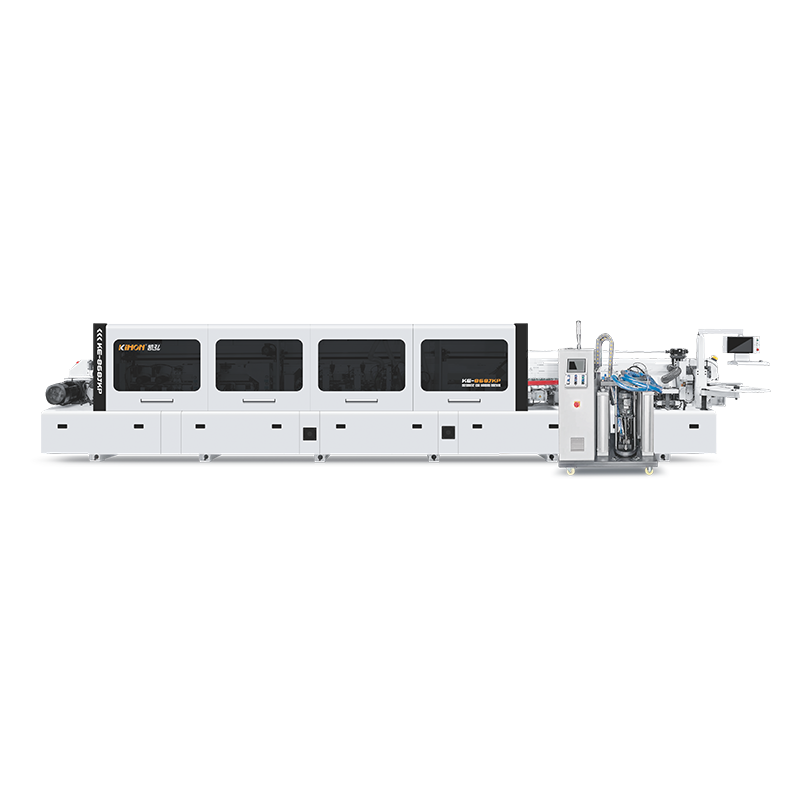
Conversely, standard wood composites are not the only materials that benefit from advanced application. Industries manufacturing lightweight structural panels or architectural doors often work with metal composites. These materials require highly specific heat control and pressure application. Utilizing a Special Edge Banding Machine for Aluminum Honeycomb, like the KIHON KE-868JKP equipped with a heavy-duty crawler conveyor, ensures that the reactive adhesive bonds perfectly to non-porous metallic surfaces. This specialized pressing mechanism guarantees a flawless bond without the risk of the glue curing prematurely during complex custom setups.
FAQ
How long can PUR glue stay in a no-clean glue pot without curing?
The duration polyurethane adhesive can remain in a no-clean pot without curing depends heavily on the specific engineering of the machine and the ambient environment. High-end systems utilize hermetic seals and nitrogen purging technology. By introducing inert nitrogen into the sealed chamber, the system completely displaces oxygen and ambient humidity. Under these strictly controlled conditions, the adhesive can safely remain in a liquid or easily re-meltable state for 48 to 72 hours. This allows operators to shut down the machine on a Friday afternoon and resume production on Monday morning without performing a chemical flush.
What happens if PUR glue cures inside the edge bander?
If polyurethane adhesive is left exposed to ambient humidity and fully cures inside the pot or the application rollers, it undergoes an irreversible chemical reaction. It turns into a solid mass resembling hard plastic or cured resin. Because it cannot be remelted with heat, the only way to remove it is through aggressive mechanical scraping, soaking the components in harsh industrial solvents, or completely replacing the damaged parts. This leads to massive machine downtime and expensive repair bills.
Do I still need flushing agents with a no-clean system?
Yes, but the frequency and volume of flushing agents required are drastically reduced compared to traditional setups. In a standard operation, flushing agents are necessary at the end of almost every shift to prevent the adhesive from hardening. With a no-clean system, daily flushing is eliminated. You will typically only need to use a specialized flushing agent before long-term shutdowns, such as a facility closure for a holiday week, or during scheduled preventative maintenance cycles when the mechanical components need to be disassembled and inspected.
How much does a no-clean PUR glue pot system cost compared to traditional setups?
While the initial capital investment for an edge bander equipped with a nitrogen-purged, no-clean system is higher than a standard EVA or open-pot PUR machine, the return on investment is exceptionally fast. When you factor in the elimination of daily machine downtime, the drastic reduction in wasted adhesive, and the savings on chemical flushing agents, most medium-to-large shops recoup the price difference within the first 12 to 18 months of operation.
Is PUR adhesive actually better than EVA for edge banding?
From a structural and aesthetic standpoint, PUR is objectively superior to Ethylene Vinyl Acetate. EVA is a thermoplastic adhesive; it melts when heated and solidifies when cooled, meaning it can reactivate and fail if exposed to high temperatures. PUR undergoes a chemical cross-linking process as it cures, creating a permanent, irreversible bond. This results in exceptional heat resistance and creates highly moisture-resistant panel edges. Aesthetically, it requires a significantly lower application volume, resulting in a microscopic glue line often referred to as a zero-joint, which prevents dirt accumulation and provides a seamless finish.
How does a nitrogen purge system work in edge banding?
A nitrogen purge system is a preventative mechanism designed to halt the chemical curing process of the adhesive. Because polyurethane reacts with the moisture naturally present in the air, removing the air removes the moisture. The edge banding machine is connected to a nitrogen supply. When the machine enters standby mode or is shut down for the day, the system automatically injects a precise volume of nitrogen gas into the sealed glue pot chamber. Because nitrogen is heavier than ambient air and completely inert, it creates a protective blanket over the liquid adhesive, ensuring it remains stable and ready for the next production cycle.
Ready to Optimize Your Production Line?
Stop letting outdated adhesive management dictate your production schedule. Upgrading to a fully integrated, automatic edge banding machine equipped with no-clean technology is the most effective way to guarantee consistent quality while maintaining minimal maintenance overhead. Whether you are processing high-volume commercial cabinetry or specialized aluminum honeycomb panels, having the right equipment makes all the difference. Evaluate your current operational bottlenecks and explore the advanced edge banding solutions available at KIHON Machine to find the perfect system engineered for your specific manufacturing needs.

![English]()
![zhifufuben]()