-
- CNC Panel SawCNC Router MachineAutomatic Edge Banding MachineSix Sided CNC Drilling Machine
- Application
![news]()
CNC Router Machine for Small Business: Best Choice Guide
Views: 0 Author: Site Editor Publish Time: 2026-07-18 Origin: Site
![facebook sharing button]()
![twitter sharing button]()
![line sharing button]()
![wechat sharing button]()
![linkedin sharing button]()
![pinterest sharing button]()
![whatsapp sharing button]()
![sharethis sharing button]()
Transitioning from manual cutting to automated routing is a major step for any fabrication shop. Buying industrial equipment carries heavy operational risk. Pick the wrong machine, and you face bottlenecked workflows, ruined material, and stranded capital. You need a reliable CNC Router Small Business solution that handles your daily volume. This guide provides a technical evaluation framework. We align machine specifications like spindle power, drive systems, and frame rigidity with your actual production requirements. You will learn how to evaluate mechanical components, understand software ecosystems, and prepare your facility for installation. We focus on matching technical capabilities to your primary materials to ensure long-term operational efficiency.
Match Machine to Material: Spindle speed, torque, and frame rigidity must be dictated by the primary materials processed (e.g., cabinet plywood vs. non-ferrous metals), not just budget.
Software Ecosystem is Critical: The physical machine is only as effective as the CAD/CAM software driving it; compatibility and operator learning curves directly impact time-to-profitability.
Facility Readiness is Non-Negotiable: True production setups require specific infrastructure, including adequate power supply (often 220V or 3-phase), climate control, and industrial dust extraction.
Defining Your Production Setup: Baseline Success Criteria
High-Margin and Profitable Applications
Identifying your primary application dictates every hardware choice you make. Custom cabinetry requires large work envelopes to process standard sheet goods efficiently. You need a machine that can handle full 4x8 or 5x10 sheets of plywood or melamine without requiring operators to break down materials on a panel saw first. Localized architectural millwork demands high Z-axis clearance for thick hardwood components. If you are carving custom corbels or thick stair treads, a standard six-inch Z-travel will not provide enough clearance for long tooling.
Nested plastic component fabrication relies on rapid traverse speeds and superior vacuum hold-down systems. Plastics like HDPE or acrylic require specific chip loads to prevent melting, meaning your machine must maintain high feed rates consistently. Non-ferrous metal parts require immense frame rigidity and specialized cooling mechanisms. High-end wooden signage needs high-RPM spindles for intricate V-carving detail. Define your sweet spot work envelope early. Standard sheet processing requires a vastly different machine footprint than high-precision small-format parts.
Volume Versus Precision Requirements
You must define the difference between high-mix prototyping and continuous batch production. High-mix, low-volume shops change setups frequently. They benefit from versatile clamping systems, such as T-slot beds, and intuitive controller interfaces that allow operators to load new programs quickly. Continuous batch production demands robust automation. If you cut the same cabinet parts all day, you need a vacuum bed and an automatic tool changer to minimize operator intervention.
Tolerance requirements dictate the necessary mechanical precision of the machine. Aerospace or medical prototyping often requires tolerances of +/- 0.001 inches. This mandates closed-loop servo motors, heavy cast-iron frames, and precision ground ball screws on all axes. General woodworking can tolerate looser margins, often around +/- 0.015 inches. However, consistent precision prevents secondary sanding and finishing operations. If your parts come off the router with chatter marks, your team will waste hours sanding edges.
Material Capabilities and Limitations
Spindle and feed rate requirements vary drastically across materials. Softwoods and MDF require high spindle speeds and rapid feed rates to prevent burning. Hardwoods demand higher torque at lower RPMs to maintain clean chip loads. Plastics require specialized single-flute tooling and precise speed control to prevent melting the material to the bit. Cutting non-ferrous metals like aluminum or brass introduces extreme mechanical stress.
You need high rigidity to prevent tool deflection when cutting metal. Micro-drop coolant systems are necessary to prevent excessive tool wear and part deformation. A machine built solely for foam or balsa will fail catastrophically when introduced to aluminum billets. The gantry will flex, the bit will chatter, and you will snap expensive carbide tooling. Always size your machine's rigidity based on the hardest material you plan to cut regularly.
Space and Infrastructure Constraints
Physical footprint requirements extend far beyond the machine dimensions. You need adequate clearance for material loading, unloading, and maintenance access. Forklift access is often necessary for loading heavy MDF bunks directly onto a scissor lift next to the machine. Electrical prerequisites dictate facility readiness. Standard 110V power limits spindle size and vacuum capabilities. Serious production requires 220V single-phase or true 3-phase power.
Environmental controls matter significantly for precise tolerance work. Temperature fluctuations cause thermal expansion in linear rails and ball screws. If your shop swings from freezing in the morning to hot in the afternoon, your cut dimensions will drift. Humidity control prevents wood stock from warping before processing. A warped sheet of plywood will lose vacuum seal, causing the part to shift mid-cut and ruining the entire sheet.
![CNC Router Machine for Small Business Workshop]()
Categorizing the Market: From Startup to Industrial
Benchtop and Desktop Models
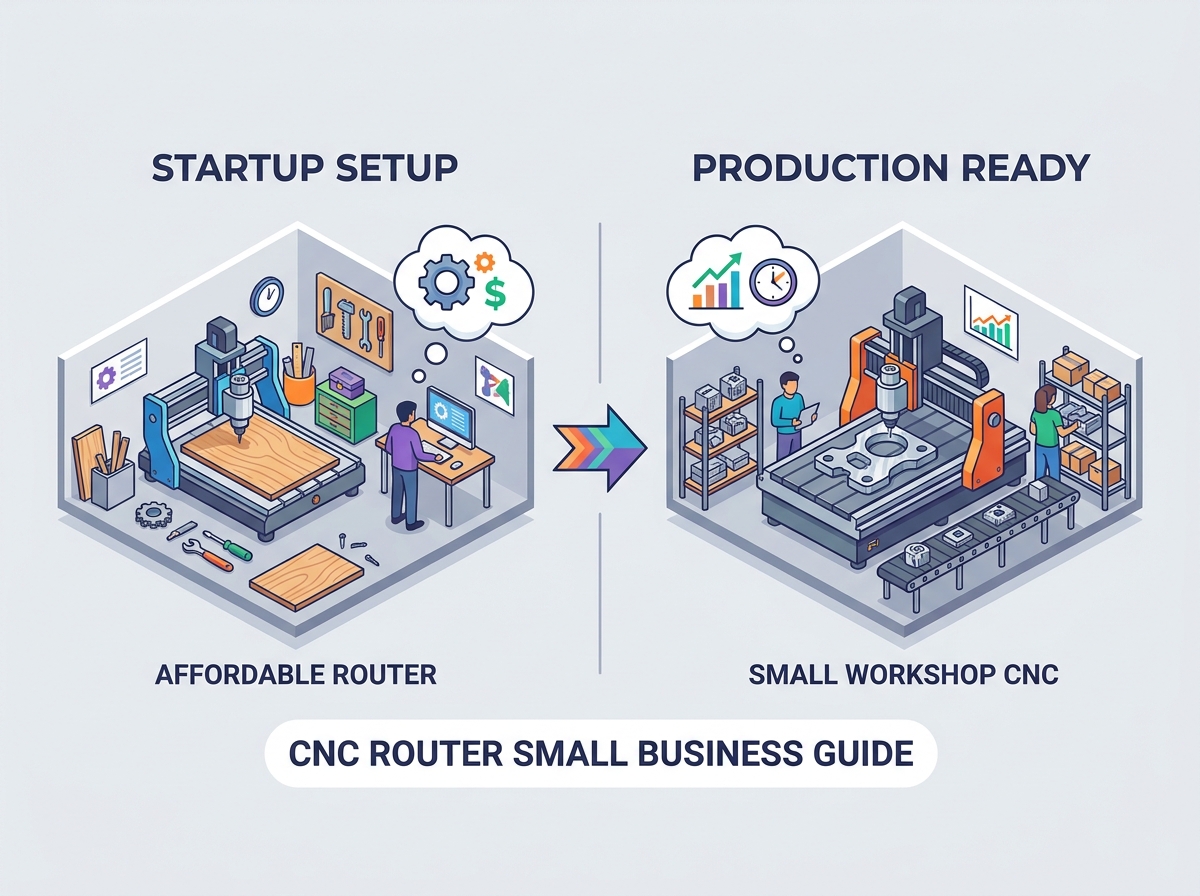
A startup cnc machine focuses on small crafts, PCB milling, prototyping, or custom jewelry. These machines fit on standard workbenches. They utilize smaller work envelopes, typically 2x2 or 2x3 feet. Spindles are often lower-wattage router motors rather than true industrial spindles. Frames consist of lighter aluminum extrusions. These models struggle with full-sheet goods or heavy metal cutting.
They serve perfectly as entry points for learning g-code and basic CAM principles. However, they lack the mass required for vibration-free aggressive cutting. If you push a desktop machine too hard, the aluminum frame flexes, resulting in poor edge quality. These machines are best suited for shops where space is severely limited and the primary materials are softwoods, plastics, or tooling board.
Mid-Range 4x4 and 4x8 Routers
This category represents the sweet spot for a small workshop cnc focused on cabinetry, sign-making, or furniture. These machines transition to heavier frames. You will find cast iron or hybrid structural steel construction. Vacuum beds become standard, allowing rapid sheet processing. Higher-torque spindles handle full sheet goods effortlessly. Linear profile rails replace V-wheels for improved accuracy.
These routers bridge the gap between hobbyist tools and heavy industrial equipment. They offer enough rigidity for occasional aluminum work while excelling at daily wood processing. An affordable router in this class often features stepper motors and air-cooled spindles. They provide excellent value for shops running single shifts. You can process a kitchen's worth of cabinet parts in a few hours, drastically reducing your lead times compared to manual table saw cutting.
Entry-Level Commercial and Industrial Routers
Continuous operations require a dedicated production setup running eight or more hours a day. These machines feature automatic tool changers (ATC) to eliminate manual intervention. Frames utilize heavy cast-iron or thick welded steel to absorb aggressive cutting vibrations. Multi-zone vacuum tables hold warped materials flat. Advanced AC servo motors provide rapid acceleration and flawless positional accuracy.
These systems integrate seamlessly with automated loading and unloading systems. They are built for maximum uptime and minimal maintenance interventions. Industrial routers use helical rack and pinion drives for the X and Y axes, allowing for rapid positioning speeds between cuts. The spindles are typically liquid-cooled, allowing them to run continuously without overheating. If your business relies on high-volume output to meet contracts, this tier is mandatory.
Core Evaluation Dimensions: Translating Features to Business Outcomes
Drive Systems and Motors: Speed vs. Accuracy
Drive systems determine how quickly and accurately the gantry moves. Stepper motors are cost-effective but carry a risk of lost steps under heavy loads. If a stepper loses position, the machine ruins the part. Closed-loop steppers add encoders to verify position, offering a reliable middle ground. AC Servo motors represent the industrial standard. They operate in a continuous closed loop, offering superior high speed, rapid acceleration, and flawless accuracy.
Transmission types also vary significantly. Lead screws are budget-friendly but slow, often found on desktop machines. Ball screws offer high precision but suffer from whip over long distances, making them unsuitable for the long axis of a 4x8 table. Helical rack and pinion systems are best for large tables. They provide high speed and excellent durability, transferring power efficiently from the motor to the gantry.
Motor Type
Feedback Loop
Speed & Acceleration
Best Application
Standard Stepper
Open Loop (No feedback)
Low to Medium
Desktop routing, light materials
Closed-Loop Stepper
Closed Loop (Encoder)
Medium
Mid-range woodworking, signs
AC Servo Motor
Closed Loop (Continuous)
Very High
Industrial production, high precision
Spindle Power, Cooling, and Speed Control
Spindle power ratings, measured in HP or kW, correlate directly to cut depth, tool diameter, and feed rates. A 1.5kW spindle handles light engraving and thin plastics. A 6kW spindle plows through thick hardwoods in a single pass using large diameter compression bits. Cooling methods impact maintenance and longevity. Air-cooled spindles require lower maintenance and are ideal for dusty wood environments. They run louder than liquid-cooled alternatives.
Water-cooled spindles run quieter and handle continuous long runs better. They require dedicated coolant maintenance, flow monitoring, and antifreeze if your shop drops below freezing. Variable Frequency Drives (VFD) are critical components. They allow precise RPM adjustments based on specific tooling and material pairings. A properly programmed VFD ensures the spindle maintains torque even at lower RPMs, which is essential when drilling or cutting heat-sensitive plastics.
Frame Construction, Vibration Dampening, and Bed Style
Machine weight is a primary indicator of cut quality and surface finish. Mass absorbs vibration. Bolt-together aluminum extrusions suffer from chatter during aggressive cuts, leaving poor edge finishes that require sanding. Welded steel gantries and cast-iron supports reduce vibration significantly. A heavy machine stays planted on the floor, allowing the motors to push the tooling through the material without the frame deflecting.
Bed configurations dictate workflow efficiency. T-slot mechanical clamping tables work well for solid wood and custom fixtures. High-flow vacuum zoning tables hold sheet goods securely. They drastically cut cycle times by eliminating manual clamping. You simply drop the sheet on the bed, open the vacuum valves, and start the program. Future-proofing features matter. The availability of a 4th-axis rotary attachment allows processing of 3D cylindrical carvings and turned spindles.
Controllers and Software Compatibility
The controller translates g-code into physical movement. Common interfaces include Mach3/Mach4, GRBL, and DSP handhelds. Industrial machines often use proprietary controllers like Syntec or Osai. Integration with industry-standard CAD/CAM software is critical. Programs like VCarve Pro, Fusion 360, and Aspire dominate the market. You must ensure post-processor availability for your specific controller to avoid g-code translation errors.
Physical machine safety features add significant value. Auto-lubrication systems extend rail life by delivering metered oil to the bearing blocks automatically. Limit switches prevent mechanical crashes by stopping the machine before it hits the end of travel. Z-axis touch plates automate tool height setting, reducing setup times and eliminating the paper-test method for finding material zero.
Implementation Risks and Mitigation Strategies
Common Purchase and Calibration Mistakes
Many buyers fall into critical traps during the acquisition phase. Purchasing a machine with an underpowered frame limits future spindle upgrades. A weak frame simply cannot handle the torque of a larger motor. Neglecting axis alignment and squareness testing during setup ruins dimensional accuracy. Your parts will not fit together if the gantry is out of square. You must tram the spindle to ensure it is perfectly perpendicular to the bed.
Forgetting to surface the sacrificial spoilboard before the first run is a common error. The spoilboard must be perfectly parallel to the gantry to ensure consistent cut depths across the entire table. You use a large fly-cutter bit to skim a few thousandths of an inch off the MDF spoilboard. This process compensates for any slight variations in the machine frame or the concrete floor it sits on.
The Operator Learning Curve
The machine does not run itself. The CAD/CAM learning curve is steep and often underestimated. Operators must understand vector design, toolpath generation, and machine control. Budgeting for dedicated operator training is essential. Utilizing CAM feeds and speeds calculators prevents bit breakage and ruined materials. You must calculate the correct chip load for every tool and material combination.
Vendor-supplied tutorials and simulation software help bridge the knowledge gap. Simulating toolpaths before running the machine catches collision errors safely in the digital environment. A good operator knows how to listen to the machine. The sound of the cut tells you if the feed rate is too fast, the RPM is too high, or the bit is getting dull. Training your staff to recognize these audio cues prevents catastrophic tooling failures.
Facility Preparation and Safety Compliance
Inadequate dust collection poses severe risks. Combustible dust hazards threaten facility safety. Fine particulate causes premature linear rail wear by mixing with bearing grease to form an abrasive paste. Operator respiratory health is compromised without proper extraction. You must size a cyclone dust collector appropriately for your spindle and material volume. A standard shop vac will not keep up with a commercial router.
Ensure emergency stop (E-stop) accessibility from multiple points around the machine. Maintaining compliance with local workplace safety regulations prevents fines and protects your workforce. Proper grounding prevents static buildup in dust hoses. Static discharge can interfere with the machine's electronics, causing lost steps or controller crashes. Run a bare copper wire through the inside of your dust collection hoses and ground it to the machine frame.
Vendor Support and Parts Availability
Purchasing imported machines with no domestic support footprint carries immense operational risk. Downtime destroys production schedules. You need access to immediate troubleshooting. Prioritize vendors with robust technical support and active user forums. Readily available standardized replacement parts are crucial. Proprietary, long-lead components leave your machine idle for weeks.
Standard linear rails, bearings, and electrical components ensure you can source replacements locally if necessary. Ask the manufacturer for a list of consumable parts and keep them in stock. Proximity sensors, VFDs, and collet nuts are common failure points that should be kept on the shelf. A reliable vendor will provide a comprehensive maintenance schedule and wiring diagrams to help your internal maintenance team troubleshoot issues quickly.
Conclusion
Define your maximum work envelope and preferred bed type based on your primary material dimensions.
Calculate the required spindle power and frame rigidity needed to cut your toughest materials efficiently.
Verify CAD/CAM software compatibility and secure the correct post-processors before finalizing the machine purchase.
Prepare your facility infrastructure, ensuring adequate electrical supply and industrial dust extraction are installed.
Request physical sample cuts from the manufacturer using your own design files to validate machine performance.
FAQ
Q: What is the best CNC router size for a small workshop?
A: A 4x8 foot table is the industry standard for processing full sheet goods like plywood and MDF. If your shop is space-constrained and focuses primarily on solid wood furniture or signage, a 4x4 or 2x3 foot machine provides adequate capacity while saving valuable floor space.
Q: Do I need an Automatic Tool Changer (ATC) for my business?
A: ATCs are essential for high-volume, multi-tool jobs. They drastically reduce manual labor and setup times by swapping bits automatically. If your production involves complex parts requiring roughing, finishing, and drilling passes, an ATC is highly recommended for continuous operation.
Q: What power supply is required for a commercial CNC router?
A: Desktop models run on standard 110V power. Commercial routers require 220V single-phase or 3-phase power. Larger spindles, powerful vacuum pumps, and industrial dust collectors demand robust electrical infrastructure. Always consult an electrician to verify your facility can handle the required amperage.
Q: Can a lightweight router cut aluminum and brass?
A: While possible with extremely shallow passes and slow feed rates, cutting non-ferrous metals efficiently requires a highly rigid frame. Lightweight extrusions suffer from vibration and tool deflection. Dedicated metal cutting requires heavy cast-iron mass and specialized micro-drop cooling systems.
Q: What software do I need to run a CNC machine?
A: You need a three-part software stack. CAD software is used for designing the vector artwork or 3D models. CAM software generates the toolpaths and calculates feeds and speeds. Finally, control software sends the resulting g-code to the machine's motors to execute the cuts.

![English]()
![zhifufuben]()