-
- CNC Panel SawCNC Router MachineAutomatic Edge Banding MachineSix Sided CNC Drilling Machine
- Application
![news]()
How Does Servo Control Improve Repeatability on an Electronic Panel Saw?
Views: 0 Author: Site Editor Publish Time: 2026-10-28 Origin: Site
![facebook sharing button]()
![twitter sharing button]()
![line sharing button]()
![wechat sharing button]()
![linkedin sharing button]()
![pinterest sharing button]()
![whatsapp sharing button]()
![sharethis sharing button]()
Are inconsistent cuts wasting costly materials and bottlenecking your assembly line? In high-volume woodworking and furniture manufacturing, mechanical wear inevitably destroys cutting precision over time. A traditional setup performs well on day one. However, as components stretch and grind under heavy industrial loads, that initial accuracy quickly fades.
A servo-driven CNC saw fixes this fundamental flaw. It ensures flawless and repeatable cuts across every single shift. This technology transforms a manual, error-prone environment into a highly efficient production floor. In this comprehensive engineering guide, we will explore the underlying technology of servo systems, distinguish between accuracy and repeatability, and explain why upgrading your machinery is a strategic necessity for modern manufacturers.
Key Takeaways
Servo Control Basics: Servo systems utilize a closed-loop feedback mechanism. They continuously monitor and adjust the blade and carriage positions, effectively eliminating positioning errors in real-time.
Repeatability vs. Accuracy: Accuracy means hitting a specific measurement once. Repeatability means hitting that exact measurement thousands of times without a microscopic margin of deviation. Servo motors excel at the latter.
Waste Reduction: Enhanced uniformity drastically reduces material scrap and costly rework. This directly improves your operational bottom line.
Scoring Blade Synergy: Servo controls guarantee pristine and chip-free edges on delicate materials like melamine and veneered boards when paired with a dual-blade system.
Bottom-Line Impact: Investing in high-quality automated cutting equipment lowers ongoing maintenance costs. It accelerates production cycles and future-proofs your manufacturing facility against mechanical degradation.
Understanding the Anatomy of a Modern Panel Cutting Machine
Factory managers transitioning from manual table saws to automated solutions must understand the core anatomy of modern cutting machinery. The underlying mechanics dictate how well the equipment will perform under heavy industrial stress.
The Core Functionality
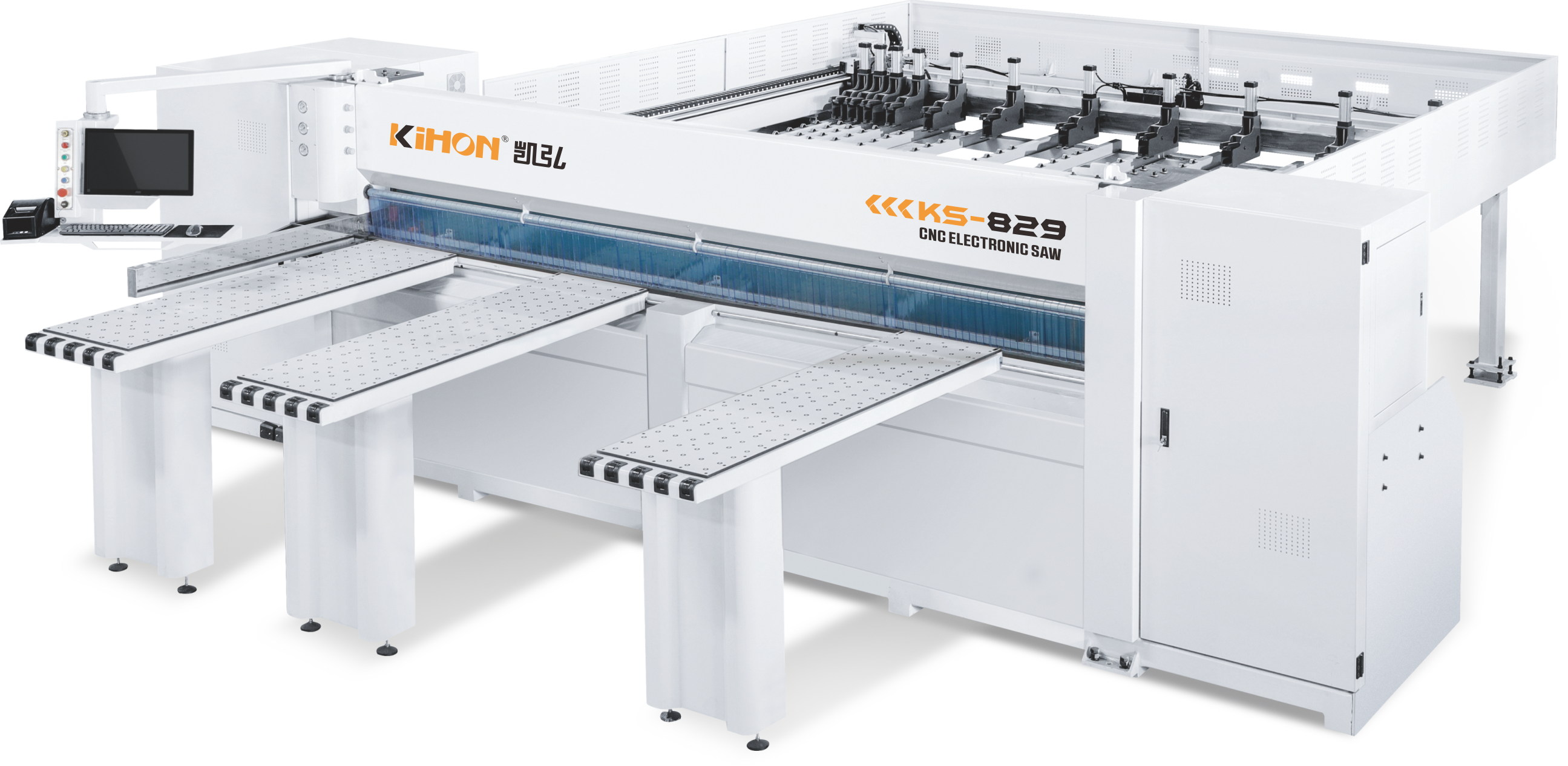
An electronic panel saw is a highly automated computer-numerically-controlled machine. It is designed to process large sheets of wood, plastic, non-ferrous metals, or composite materials into smaller, precise rectangular parts. Traditional manual saws rely on the operator's physical measurements and pushing force. In contrast, this advanced equipment uses motorized carriages, programmable pushers, and sophisticated software to execute complex cutting patterns automatically. These machines represent the gold standard for high-volume automated precision cutting.
The Crucial Role of the Dual-Blade System
A defining feature of industrial panel processing is the dual-blade configuration. The machine utilizes a smaller blade positioned directly in front of the main cutting blade. This secondary blade spins in the opposite direction. It makes a very shallow slice on the bottom surface of the material. Its primary function is to pierce through delicate surface layers before the larger main blade cuts through the core. This two-step process prevents chipping and tear-out on the underside of the panel. The result is a clean, factory-grade edge ready for immediate edge banding.
The Shift from Stepper Motors to Servo Motors
Historically, automated saws relied on stepper motors or pneumatic cylinders to move the material and the saw carriage. Stepper motors operate on an open-loop system. They receive an electrical pulse to move a certain distance but lack the ability to verify if they actually reached that physical position. A stepper motor might stall or lose steps if the blade encounters a dense knot in a stack of plywood. This results in a ruined panel. Modern machines have shifted to servo motors, completely solving this flaw through constant digital communication.
Industry Trends: The Growing Demand for Automated Precision
Current manufacturing data reveals a sharp pivot toward closed-loop CNC architectures in the woodworking and plastics sectors. The demand for batch-size-one production has skyrocketed globally. Factories now require custom, individualized parts produced at mass-manufacturing speeds.
Furthermore, a persistent shortage of skilled machine operators forces shop owners to rely on machine intelligence rather than human experience. In the past, a seasoned operator could listen to the pitch of the saw blade and manually adjust the feed rate to prevent tear-out. Today, manufacturers must rely on the dynamic torque adjustments of servo drives to perform these micro-corrections autonomously. Coupled with skyrocketing raw material costs, the tolerance for scrapped parts has plummeted to near zero. Unwavering precision is no longer a luxury. It is a baseline requirement for competitive survival.
![CNC Electronic Panel Saw]()
Demystifying the Drive: How Do Servo Systems Work?
Appreciating why servo control is vastly superior requires a look at the engineering principles governing these advanced drive systems. It is not merely about raw speed. It is about absolute, unyielding consistency.
The Closed-Loop Feedback Architecture
The core advantage of a servo system is its closed-loop feedback architecture. A servo motor is equipped with an internal sensor known as an encoder. The encoder reads the exact physical position as the motor turns and sends this data back to the machine's central controller.
A traditional stepper motor operates blind. You send an electrical pulse, but the controller never verifies the final physical position. In contrast, a servo motor operates with constant awareness. The system recognizes deviations caused by friction or load changes and adjusts the steering and speed accordingly.
Continuous Micro-Adjustments
The servo drive reads position data from the encoder thousands of times per second during a live cutting cycle. The saw carriage might fall a fraction of a millimeter behind its target position due to mechanical resistance. When this happens, the controller instantly supplies more current to the motor to correct the error. This continuous cycle of reading, comparing, and correcting ensures that the saw carriage speed, torque, and position remain exactly as programmed.
Accuracy vs. Repeatability: Why Consistency is King
Accuracy and repeatability are often used interchangeably by laymen. However, they represent two distinct engineering concepts. Understanding this difference is critical to optimizing your factory floor for large-scale panel processing.
Defining Accuracy in Panel Cutting
Accuracy refers to the machine's ability to hit an exact requested measurement. You might program the saw to cut a panel to exactly 600.0mm. If the resulting part measures 600.0mm, the machine is highly accurate. Accuracy is primarily determined by the initial calibration and setup of the machine.
Defining Repeatability
Repeatability is the machine's ability to perform that exact same operation multiple times under identical conditions. Repeatability is the ability to process 500 consecutive panels with every single piece measuring exactly 600.0mm. There can be no microscopic margin of deviation.
Bridging the Gap with Servo Control
Traditional machines lose repeatability over time due to mechanical wear. Belts stretch, gear teeth wear down, and chassis components experience thermal expansion. Stepper motors cannot detect these physical changes, causing the cuts to gradually drift out of tolerance. Servo systems bridge this gap by relying on digital encoder data rather than purely mechanical linkages. The mathematical algorithms within the servo compensate for microscopic mechanical wear. This guarantees that the final cut on Friday afternoon is functionally identical to the first cut on Monday morning.
Engineering Breakdown: How Servo Control Directly Improves Repeatability
The integration of servo technology impacts the physical cutting process in several measurable ways. By continuously monitoring internal parameters, these systems eliminate the micro-errors that plague older machinery.
Performance Metric
Traditional Stepper System
Advanced Servo Control
Feedback Mechanism
Open-loop. Blind to actual physical positioning errors.
Closed-loop. Continuous real-time position verification via encoders.
Mechanical Backlash
Compounds over time as gears and belts wear down.
Digitally compensated. The motor micro-adjusts to negate gear slop.
Torque Response
Static. Blades can bog down or deflect in dense material knots.
Dynamic. Injects current instantly to maintain constant RPM and cut quality.
Motion Profile
Abrupt starts and stops cause chassis vibration.
S-curve acceleration ensures fluid, vibration-free carriage travel.
Elimination of Mechanical Backlash
Mechanical wear is inevitable in traditional rack-and-pinion or belt-driven saw carriages. Gears develop slight gaps over months of heavy operation. This creates play known as mechanical backlash. Commanding a 500mm movement might yield a 499.5mm physical travel due to this backlash. Half a millimeter seems negligible. Yet, this error compounds over multiple cuts, destroying joint tolerances.
Servo motors combat this through high-resolution absolute encoders. The closed-loop feedback system detects the error instantly if mechanical wear introduces a discrepancy. It commands the motor to rotate a fraction of a degree further. This digital correction ensures the mechanical carriage arrives at the precise coordinate every single time.
Precise Carriage Positioning and Speed Control
Achieving a perfect cut is highly dependent on the stability of the saw carriage as it travels. Traditional motors struggle with abrupt starts and stops. This causes jerky movements that create blade deflection or visible chatter marks on the panel edge.
Advanced servo drives utilize sophisticated controllers to manage acceleration and deceleration curves, known as S-curve profiles. The saw carriage smoothly ramps up to maximum cutting speed and gently decelerates as it exits the material. This fluid motion prevents the heavy mechanical chassis from shuddering. The blade engages the material with identical force and angle every time.
Dynamic Torque Adjustment
Woodworking substrates are rarely uniform. A stack of high-density fiberboard presents significantly more resistance than standard particleboard. The motor RPM drops slightly when a traditional saw blade hits a dense patch. This causes the blade to bog down or deflect off its axis.
Servo motors feature dynamic torque adjustment. The drive continuously monitors the electrical current drawn by the motor. The drive injects more current within milliseconds to increase torque if the blade encounters a denser section. This real-time power modulation maintains a constant RPM, preventing blade deflection and guaranteeing a perfectly straight cutting path.
Flawless Synchronization with the Scoring Blade
Processing delicate materials requires a dual-blade setup to prevent chipping. The success of this process hinges on the absolute alignment of the two blades. The secondary blade will create a stepped edge rather than a flush surface if it is misaligned by even a fraction of a millimeter.
In a high-end scoring blade panel saw, servo controls govern the exact depth, lateral positioning, and synchronization of both blades. The system ensures the scoring blade makes its shallow, reverse-rotation cut at the exact coordinate required. This paves a flawless path for the main blade. Operators can trust that this alignment will remain perfectly synchronized across thousands of operating cycles without manual recalibration.
Environmental and Thermal Compensation
Industrial manufacturing environments are subject to significant temperature fluctuations. The friction generated by linear guide rails and bearings causes the metal components of the saw to heat up and microscopically expand during a heavy 12-hour shift. This thermal expansion leads to a slow but steady drift in repeatability in standard machines.
Modern servo systems dynamically account for thermal expansion. The algorithm offsets the cutting coordinates to compensate for physical expansion in the machine's chassis by utilizing temperature sensors and relying on absolute positioning data. A panel cut in a freezing factory at dawn will have the exact same dimensions as one cut during the peak heat of the afternoon.
The Business ROI of a Servo Controlled Saw
Transitioning to advanced machinery requires a larger initial capital expenditure compared to purchasing standard equipment. Industrial manufacturers must evaluate this decision through the lens of Return on Investment. The enhanced repeatability directly impacts the bottom line by addressing three critical operational costs.
Drastic Reduction in Material Waste
Material costs often represent the largest ongoing expense in furniture and cabinetry manufacturing. A traditional saw produces panels that are out of tolerance when it loses repeatability. These miscuts often go unnoticed until they reach the assembly stage. This results in the scrapping of expensive MDF, plywood, or high-pressure laminates.
By investing in a servo controlled panel cutting machine, factory managers effectively eliminate the margin for human and mechanical error. The machine cuts exactly what the optimization software dictates every single time. Reducing material waste by even a few percentage points annually can save tens of thousands of dollars.
Faster Assembly Down the Line
Bottlenecks rarely occur at the cutting stage in modern manufacturing. They usually manifest during assembly. Downstream processes become entirely frictionless when panels are cut with absolute repeatability. Edge banders can apply tape seamlessly without adjusting for uneven edges. CNC point-to-point routers receive perfectly squared panels, ensuring that pre-drilled dowel holes align flawlessly.
Overall production speed skyrockets when operators do not have to waste time manually sanding edges or forcing mismatched joints to fit. This flawless consistency transforms a disjointed woodworking shop into a highly synchronized continuous-flow production line.
Lower Maintenance and Downtime
Traditional brushed motors and complex pneumatic positioning cylinders require constant maintenance. Brushes wear out, pneumatic seals degrade, and air pressure fluctuates. All of these issues lead to unplanned machine downtime.
Servo motors are brushless and rely on magnetic fields to generate motion. This makes them virtually maintenance-free. Modern servo drives are equipped with intelligent self-diagnostics. They monitor internal temperatures, voltage irregularities, and torque spikes. The system alerts operators to potential mechanical bindings long before a catastrophic failure occurs.
Equipment Selection Guide: What to Look For
Not all automated saws are engineered to the same standard. It is crucial to evaluate the specific components that contribute to the machine's repeatability if you are preparing to upgrade your facility. Look for specific industrial benchmarks during the procurement process.
Robust Motor Specifications
A top-tier industrial saw must possess sufficient cutting power to handle stacked panels and dense substrates without bogging down. Look for machines equipped with a heavy-duty main motor, typically around 15kW, paired with a dedicated 1.5kW to 2.2kW scoring motor. This configuration guarantees relentless torque.
High-Speed Carriage Capabilities
Throughput is just as important as precision. High-performance servo drives should enable the saw carriage to achieve rapid travel speeds. Industry-leading models push carriage speeds up to 100 or 120 meters per minute. This drastically reduces the cycle time between cuts.
High-Resolution Absolute Encoders
The precision of a servo system is dictated by the resolution of its encoder. Inquire about the bit-rating when evaluating machines. Top-tier industrial saws utilize 20-bit or 24-bit absolute encoders. A higher bit rating means the motor divides a single rotation into millions of distinct digital steps. Absolute encoders are preferable because they never lose their position data during a power outage.
Heavy-Duty Frame Construction
Even the most advanced motors cannot compensate for a weak chassis. High-speed servo acceleration generates significant kinetic energy. This energy translates into vibration if the machine frame is lightweight. Ensure the saw features a heavy-duty, stress-relieved steel frame riding on precision-ground linear guide rails. Standard cutting lengths should comfortably accommodate large industrial boards, typically offering 3200mm to 3800mm capacities.
Real-World Applications: Who Needs This Technology?
Several industrial sectors rely on this technology to remain competitive and profitable, even if small hobbyist shops may not require extreme precision.
Custom Cabinetry and Kitchen Manufacturers
There is zero tolerance for error for manufacturers producing frameless European-style cabinetry. Cabinet boxes rely on perfectly square panels to ensure that doors hang straight and drawers glide smoothly. These manufacturers predominantly work with double-sided melamine or high-gloss acrylics. This requires the exact synchronization of dual blades to achieve chip-free edges.
Mass Furniture Production
Machines are often required to run across multiple shifts per day in high-volume flat-pack furniture manufacturing. Output volume and consistency are the primary metrics. Servo-driven saws excel here due to their rapid acceleration capabilities. Their thermal compensation algorithms ensure that panels cut during the night shift match the exact dimensions of those cut during the morning shift.
Aerospace and Specialty Plastics
Automated cutting is not limited to woodworking. Facilities that process advanced materials like polycarbonate, acrylics, and aluminum composite panels face unique challenges. These materials are incredibly expensive. A single miscut carries a heavy financial penalty. Plastics are sensitive to heat, so servo systems allow operators to dial in the exact non-fluctuating feed rate required to prevent melting.
Conclusion & Next Steps
Upgrading to an advanced CNC saw equipped with servo control fundamentally transforms a manufacturing floor. It replaces an error-prone, manually monitored cutting process with a highly efficient, automated, and mathematically precise system.
The payback period is remarkably short. The drastic elimination of material waste, the acceleration of downstream assembly, and the reduction in unplanned machine downtime directly contribute to a healthier profit margin. Investing in true closed-loop precision is a strategic necessity to future-proof your business.
Ready to eliminate miscuts and accelerate your assembly line? Explore the full range of high-precision equipment at Kihon Machine. Our engineering team can help you select the exact configuration, cutting capacity, and motor specifications to meet your heavy-duty production demands.
FAQ
What is the difference between open-loop and closed-loop systems in panel saws?
An open-loop system sends an electrical command to the motor to move a specific distance but never verifies if the motor actually reached that position. If mechanical resistance causes the motor to stall, the controller remains unaware, resulting in an inaccurate cut. A closed-loop system uses an encoder to constantly measure the motor's actual physical position and feeds that data back to the controller. If there is a discrepancy, the system corrects it instantly.
How does thermal expansion affect CNC panel saw precision?
During extended operation, the friction from moving parts causes the metal frame and guide rails of the saw to heat up and slightly expand. In traditional machines, this microscopic expansion alters the physical distance between the blade and the positioning pusher, leading to dimensional drift. Advanced servo systems use thermal compensation algorithms to digitally offset these changes, maintaining exact tolerances regardless of machine temperature.
Can a standard electronic panel saw be upgraded to servo control?
Retrofitting is rarely practical or cost-effective. A true servo system requires a highly rigid frame, precision linear guides, and an advanced CNC controller to process the closed-loop feedback. Upgrading a standard saw often results in mismatched components. It is much more reliable to invest in a purpose-built machine where the mechanical chassis, optimization software, and motors are engineered to work in perfect harmony.
How does a scoring blade panel saw differ from a standard table saw?
A standard table saw uses a single large blade to cut through the material, which often causes tear-out as the blade's teeth exit the bottom of the panel. A dual-blade system utilizes a smaller secondary blade situated just in front of the main blade. This scoring blade spins in the opposite direction and makes a very shallow cut on the bottom veneer. When the main blade follows through, the bottom edge is already severed, resulting in a clean edge on both sides.
Does servo control make the cutting process faster?
Yes, significantly. Servo motors possess dynamic torque and can accelerate and decelerate much faster than traditional motors. They reach optimal cutting speeds in a fraction of the time. Because absolute encoders provide instant positioning data, the machine does not have to pause and wait for mechanical settling or limit-switch verification. This rapid positioning drastically reduces the overall cycle time between cuts.
How often do servo motors on a panel saw need maintenance?
Servo motors are largely maintenance-free. They are brushless, meaning there are no internal carbon components that wear out and need replacing. They are also sealed against dust and debris. The primary maintenance required for a servo-driven saw is strictly mechanical. Operators must ensure that the machine's linear guide rails and rack-and-pinion gears are kept clean and properly lubricated according to the manufacturer's schedule.

![English]()
![zhifufuben]()