-
- CNC Panel SawCNC Router MachineAutomatic Edge Banding MachineSix Sided CNC Drilling Machine
- Application
![news]()
Woodworking CNC Routing for Panel Cutting Carving and Grooving
Views: 0 Author: Site Editor Publish Time: 2026-10-31 Origin: Site
![facebook sharing button]()
![twitter sharing button]()
![line sharing button]()
![wechat sharing button]()
![linkedin sharing button]()
![pinterest sharing button]()
![whatsapp sharing button]()
![sharethis sharing button]()
Are you still breaking down plywood sheets by hand? Manual processing drains physical energy. Worse, it introduces inconsistencies that ruin expensive materials. Modern woodshops face a harsh reality today. You must scale production without sacrificing quality. Transitioning to automated technology is no longer a luxury. It is a baseline requirement for survival.
In this guide, we will break down how a woodworking CNC router solves these workflow bottlenecks. We will look at its precision in flat panel cutting, intricate 3D carving, and complex grooving from a practical engineering perspective.
Key Takeaways
Versatility: A single workstation efficiently handles flat panel cutting, 3D carving, and precise joinery grooving.
Efficiency: Automated routing slashes material waste and compresses production time for cabinet makers.
Scalability: Computer-controlled equipment empowers small woodshops to compete directly with large-scale commercial manufacturers.
Machine Selection: Matching spindle power, vacuum bed configuration, and tool changers to your specific production volume is critical.
What is a Woodworking CNC Router?
Let us look at the mechanics. A Computer Numerical Control router is an automated industrial milling machine. It shapes solid wood, plywood, and medium-density fiberboard. Forget the severe limitations of hand-operated plunge routers. This equipment reads digital blueprints and drives a high-speed spinning cutting tool across the X, Y, and Z axes.
How does it work in practice? You draft a 3D model using Computer-Aided Design software. Next, Computer-Aided Manufacturing software translates those geometric shapes into exact toolpaths. This generates G-code, which acts as the machine's actual brain. The onboard controller reads this code. It executes cuts with pinpoint accuracy down to fractions of a millimeter.
For custom fabricators, this technological leap eliminates human error. Parts produced on these vacuum tables feature flawless repeatability. Cut the first sheet of melamine. Cut the fiftieth. Every single component matches perfectly. This is a non-negotiable standard in today's highly competitive manufacturing landscape.
Core Applications: Panel Cutting, Carving, and Grooving
The real value of these automated systems lies in their multifunctionality. Swap the cutting bit, load a new digital file, and your workstation pivots instantly between vastly different manufacturing tasks.
Looking at recent manufacturing data, the woodworking sector is experiencing a massive shift toward nested-based manufacturing. Driven by rising labor costs and a shortage of skilled craftsmen, shops are moving away from traditional multi-station setups. The industry trend heavily favors all-in-one automated cells that maximize material yield and reduce handling time.
Precision Panel Cutting for Furniture
Processing large unwieldy sheets forms the backbone of modern cabinetry. A dedicated panel furniture CNC cutting machine breaks down standard 4x8 or 5x10 foot sheets rapidly. Pair it with a specialized 2-flute compression bit. The spindle powers through dense core materials while simultaneously pushing delicate wood veneers toward the center of the sheet. The result is a pristine edge. You get zero tear-out on the top or bottom surfaces, leaving the board ready for immediate edge banding.
Specifically, this workflow leverages intelligent nesting algorithms. The software automatically rotates and arranges required furniture parts on the digital canvas to extract maximum yield. This smart nesting minimizes offcuts and directly bolsters your bottom line.
Intricate 3D Carving Capabilities
Can a machine capture the nuanced depth of hand carving? Absolutely. Equip the spindle with a fine 60-degree V-bit or a tapered ball-nose end mill. Driven by 3D relief software, the equipment executes breathtaking details. The machine continuously adjusts the Z-axis depth in microscopic increments as it sweeps across the wood grain. Achieving this level of symmetrical perfection by hand requires dozens of hours. The router accomplishes it flawlessly in a fraction of the time.
Seamless Grooving and Jointing
Modern flat-pack and modular furniture rely heavily on tight, precise joinery. Automated routers excel at machining blind dados, rabbets, and complex interlocking joints. Because the digital controller dictates the exact depth of the cut, operators can mill stopped grooves that terminate right before the visible edge of a panel.
In addition, digital manufacturing introduces clever techniques like dog-bone fillets. These are slight, intentional overcuts placed in the inside corners of a milled pocket. They allow square tenons to slide in perfectly without the need for manual corner chiseling, saving massive amounts of time during final assembly.
![Woodworking CNC Routing Machine in Action]()
Transforming Your Shop Floor Workflow
Integrating automated routing technology rewrites your production timeline. Global supply chain disruptions have made importing pre-fabricated cabinets highly unreliable. Consequently, domestic woodshops see a surge in demand for custom, quick-turnaround casework. To meet this demand without ballooning labor costs, adopting smart manufacturing practices is essential.
Speed and consistency drive this operational shift. A robust cabinet making CNC router processes all the necessary components for a standard kitchen installation in a single setup. It drills the 5mm shelf pin holes. It mills the structural joinery grooves. It cuts the final part outlines in one continuous sequence. This entirely replaces the tedious process of moving panels between a table saw, a drill press, and a manual router table.
Furthermore, this digital approach offers unparalleled design flexibility. Traditional shops rely on physical jigs that restrict product offerings. With a computer-controlled system, transitioning from a frameless European cabinet to a customized architectural built-in simply requires loading a different parametric file. You scale your product catalog infinitely without expanding your physical footprint.
Key Features for Machine Selection
Do not just buy based on price. Decoding the technical specifications that dictate a machine's performance is crucial. Matching the hardware to your specific production environment guarantees long-term success. Here is a practical breakdown for buyers.
Production Need
Recommended Spindle
Table Type
Tool Changer
Entry-level & Signage
3kW Water-Cooled
T-Slot Clamp
Manual
Custom Cabinetry
9kW Air-Cooled
Multi-Zone Vacuum
Linear 12-Tool
High-Volume Nesting
9kW+ with Drill Bank
Heavy-Duty Vacuum
Carousel
Spindle Power and Speed
The spindle acts as the heart of the machine. It provides the rotational force that drives the cutting bit through dense wood fibers. For light sign-making and intricate 3D carving, a 3-kilowatt spindle provides ample torque. In contrast, full-time cabinet shops slicing through thick hardwood plywood require heavy-duty performance. An industrial 9-kilowatt air-cooled spindle running at 24,000 revolutions per minute prevents motor stalling and ensures crisp, burn-free edges.
Vacuum Table Configuration
Workholding is arguably the most critical factor in automated routing. If a panel shifts even a millimeter under the sheer force of the cutter, the part is instantly ruined. T-slot tables use physical metal clamps to secure the edges. While excellent for thick hardwood slabs, clamping poses a collision risk for the router bit. For high-volume flat-pack furniture production, a multi-zone vacuum table is mandatory. High-powered pumps pull air through a porous spoilboard, sucking warped sheet goods perfectly flat against the bed.
Automatic Tool Changer
An Automatic Tool Changer is a sophisticated mechanism housing multiple router bits in a linear rack or rotary carousel. During a complex job, the machine automatically retrieves the correct tool without human intervention. By eliminating manual wrenching and Z-axis recalibration between every step, a standard 12-tool changer drastically compresses cycle times and reduces operator fatigue.
Getting Started: Essential Tools and Software
Operating this equipment requires a cohesive ecosystem of digital software and physical tooling.
The foundation of your workflow is the software stack. Industry-standard programs empower users to design interlocking panels and generate optimized cut lists automatically. On the physical side, beginners should invest in a core set of premium carbide router bits. You need compression bits for flawless plywood edges, downcut spiral bits for clean shallow dados, and various V-bits for lettering and chamfering.
When running your first jobs, always prioritize verification. Double-check your starting point to ensure the machine knows exactly where the material surface is. Run an air cut by raising the cutting head safely above the wood to visualize the toolpath. Verify that your spindle speed and feed rates are dialed in correctly to prevent tool breakage.
Top Woodworking CNC Router Machines for Production
Evaluating machine specifications is only half the battle. Partnering with a reputable manufacturer ensures your equipment maintains tight tolerances over years of heavy use. Industrial machines demand rigid steel frames, precision linear guide rails, and robust electronics. Let us look at engineered solutions meticulously tailored to different manufacturing scales.
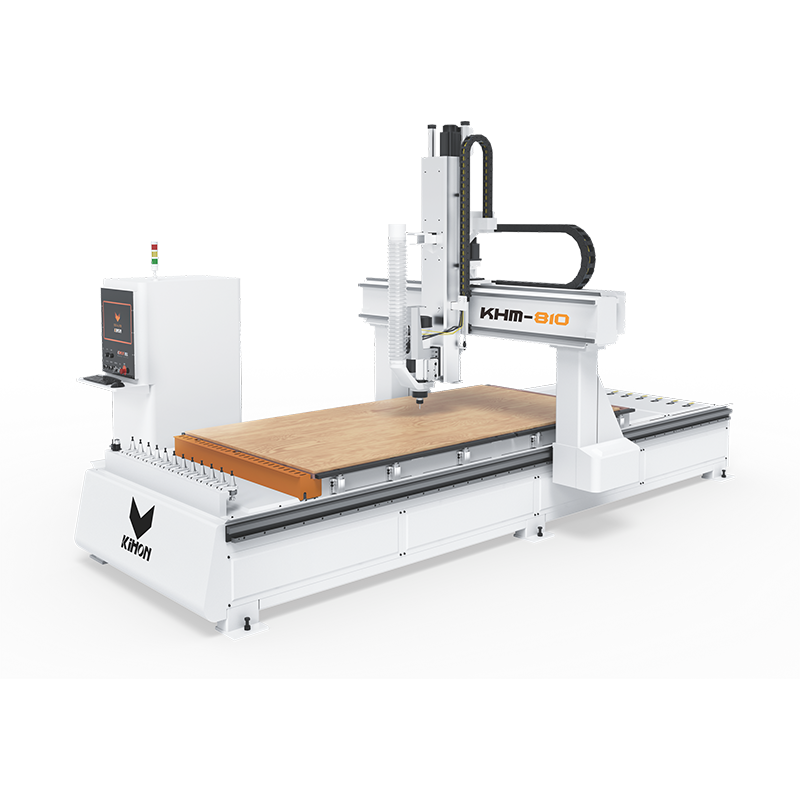
High-Efficiency Production: KHM-810 CNC Router
When your primary objective is maximizing throughput for casework, a specialized setup is required. The KHM-810 model is engineered explicitly for nested-based manufacturing. Featuring a reinforced gantry and an aggressive 9-kilowatt high-torque spindle, it effortlessly slices through dense medium-density fiberboard and stacked laminates. The integration of an industrial multi-zone vacuum bed guarantees that large sheets remain completely immobile during rapid grooving operations. For commercial fabricators prioritizing speed, this configuration significantly lowers the cost per part.
Precision Cabinetry and Carving: KN-NC2 CNC Router
Custom cabinet making demands a delicate balance between heavy material removal and intricate detailing. The KN-NC2 model is uniquely configured to handle these rigorous demands. It excels at milling perfectly snug blind dados for cabinet carcasses while retaining the finesse required to carve elegant 3D profiles on solid wood doors. Equipped with advanced tool changing capabilities and reliable control systems, operators transition from aggressive compression cutting to fine detailing in seconds.
Best Practices for Machine Maintenance
To guarantee your equipment continues to deliver peak precision, establishing a strict preventative maintenance routine is mandatory. Neglecting basic upkeep is the primary culprit behind skipped steps, rough edges, and premature spindle failure.
Wood dust acts as a highly abrasive contaminant. Ensure your dust extraction system operates at full capacity during every cycle. At the end of a shift, vacuum the machine bed, gantry, and control cabinet. If fine particulate mixes with the grease on your linear guideways, it creates a grinding paste that rapidly destroys precision bearings. Wiping down and lubricating the helical racks and linear rails with manufacturer-recommended oil is a vital weekly task.
Tool care is equally important. Machining softwoods or certain grades of plywood leaves a sticky resin buildup on the cutting flutes. This pitch increases friction, causing the bit to overheat and scorch the wood. Soaking your bits in a specialized resin cleaner restores their cutting efficiency. Routinely inspect and clean the inside of the spindle collet. Accumulated dust here causes the bit to seat improperly, leading to dangerous runout.
Conclusion
A computer-controlled router serves as the ultimate bridge between creative woodworking and high-volume, profitable production. By adopting this technology, shops eliminate workflow bottlenecks, drastically reduce material waste, and guarantee that every component is milled to exact specifications.
Whether you are focused on rapid flat panel cutting, intricate 3D carving, or machining precise interlocking grooves, there is a specific configuration designed to meet your demands. Carefully evaluate your production volume, floor space, and material requirements before upgrading.
Ready to transform your manufacturing process and scale your output? Visit Kihon Machine today to explore our industrial-grade equipment lineup and request a personalized machinery consultation.
Frequently Asked Questions
Can a CNC router carve intricate details in hardwood?
Yes, the technology is highly capable of carving intricate details into dense hardwoods like oak, maple, and walnut. Achieving this level of detail relies on utilizing fine V-bits or tapered ball-nose end mills. Specialized 3D toolpaths generated in the software control the step-over rate. A very small step-over rate, combined with a rigid machine frame that eliminates vibration, allows the router to produce decorative motifs and textures that are practically impossible to replicate consistently by hand.
What is the best CNC router for cabinet making?
The ideal machine for cabinet making must prioritize material hold-down, processing speed, and automation. It should feature a minimum working area of 4x8 feet to accommodate standard sheets of plywood. A high-capacity, multi-zone vacuum bed is non-negotiable to pull warped plywood completely flat. An Automatic Tool Changer is critical, as a standard cabinet job requires multiple bits for drilling shelf pins, cutting outlines, and profiling doors. Machines equipped with a powerful 9-kilowatt spindle provide the efficiency required for profitable cabinet manufacturing.
Is it hard to learn how to use a woodworking CNC router?
While there is a definitive learning curve, modern digital technology is more accessible than ever. The workflow is divided into designing the part, generating the toolpaths, and operating the machine. Software programs designed specifically for woodworkers feature intuitive, visual interfaces that simplify the creation of standard geometric cuts. For basic panel processing and grooving, most operators become proficient within a few days of focused training.
What materials can a wood CNC router cut besides wood?
Despite the name, these machines are highly versatile and process a wide variety of materials utilized in modern manufacturing. Beyond solid wood and plywood, they are excellent for cutting plastics like cast acrylic, polycarbonate, and High-Density Polyethylene. They also process tooling foam for architectural molds and solid surface materials used for countertops. With the correct application of specialized cutting bits and precisely adjusted feed rates, a robust machine can even mill non-ferrous soft metals like aluminum and brass.
How much does an industrial woodworking CNC router cost?
Pricing varies significantly based on specifications, frame rigidity, and build quality. Entry-level desktop machines for hobbyists may start around a few thousand dollars. However, professional-grade industrial routers equipped with 9-kilowatt spindles, multi-zone vacuum tables, and Automatic Tool Changers typically range from $15,000 to over $50,000. This capital investment pays off rapidly for commercial shops through increased production speed, drastically reduced material waste, and lower labor costs.
What is the best software for CNC wood routing?
The optimal software depends entirely on your specific application. For general 2D cutting, sign-making, and 3D carving, Vectric VCarve Pro and Autodesk Fusion 360 are industry favorites due to their intuitive interfaces. For dedicated cabinet makers, specialized parametric software like Mozaik, Cabinet Vision, or Microvellum is highly recommended. These robust programs automatically generate nested cut lists, drill patterns, and joinery toolpaths directly from your room designs.

![English]()
![zhifufuben]()